Showing posts with label horse slaughter. Show all posts

Wednesday, May 2, 2012

The Kentucky Derby Rocks & Sucks

It's almost Derby Day!


I love the Kentucky Derby. I also hate it, but we'll get to that in a few minutes. Focus on the positive: People get dressed up in huge silly hats, drink drinks they'd avoid at any other time, and are captivated by two minutes of a sport they don't understand, but love anyway. Gorgeous horses, intense action, incredible backstories-- it's all on display at the races! May 5th people-- mark your calendars!

I have a confession: I make my Derby winner pick by how awesome the horse's name is. Here's this year's field of runners (subject to change of course) and my name judgement:

Awful:
Bodemeister
Daddy Long Legs
Interestingly, there really is a complicated, rule-filled process for naming racehorses.
Daddy Nose Best
Hansen
Went the Day Well
Dullahan

Boring:
Creative Cause
Gemologist
Optimizer
Prospective
Alpha

Not Bad:
Trinniberg
Done Talking
I'll Have Another
Liaison
My Adonis
Rousing Sermon
Take Charge Indy
Union Rags

Awesome!!
El Padrino (The Godfather)
Sabercat

I think Sabercat is the cooler name, but I also love the way El Padrino flops his big ears slightly out to the side when he runs, so I'm rooting for him:


And you know what? This is a totally legitimate way to pick a winner, because basically, the horses are all the same. No, I'm not talking about the fact that they're all young (three) and have had relatively few races by which to judge their performances. No, I'm not talking about the fact that they're all basically brown except Hansen. I'm talking about the ROT that has seeped into horse racing: inbreeding.

Every single horse on the Derby field is a cousin to his or her competitors. Not just a cousin in the way that many horses of the same breed are distantly related-- we're talking close family ties here.

Go back up and click on each of the horses' names. The links will take you to their pedigrees. What do you notice? The same names, over and over and over again! Northern Dancer, Secretariat, Mr. Prospector, Bold Ruler, Seattle Slew, War Admiral and their immediate descendents were bred and re-bred and then re-bred to those they sired, effectively making the racehorse gene pool as shallow as a Kardashian in front of a camera.

"I buy myself a gift every year, so this year I bought everything I wanted." -- Kim Kardashian

The little colored boxes show when a horse has direct inbreeding in their family tree. So on Alpha's pedigree, they show that Northern Dancer is Alpha's great-grandpa AND great-great-great grandpa, and that Native Dancer appears twice as well. However, those little colored boxes just scratch the surface of the truth. Northern Dancer's grandpa was Native Dancer!

Now go look at I'll Have Another's pedigree. Northern Dancer appears three times, and Raise a Native (Native Dancer's son) appears twice.

We've just been following the Native Dancer re-breedings within five generations. Now go look at how many times the other famous horses were re-bred into family lines!

If Thoroughbreds were humans, this is probably what they'd look like:


So why does this happen? Well, of course racehorse breeders want to win, so they breed to winners, and re-breed to winners, hoping the offspring will get the magical gene combination of their illustrious ancestors.

"Winning" in this case just means the ability of young horses to go very fast for a short distance. Breeding purely for disposable speed, not for soundness/health or genetic diversity, has led Thoroughbreds down a dangerous path. As well all know, breeding heavily for certain traits results in dangerous health problems. In Quarter Horses, there's HYPP, in Arabians it's SCID, in German Shepherds it's hip dysplasia, many bulldogs can't give birth naturally because of the big-headed thing, etc etc etc.


 Thoroughbreds are being bred to look like greyhounds-- thin bones, long pasterns, skinny bodies, etc. It increases their speed-- but the delicate physique also results in more injuries. Added to the inbreeding and being raced at a young age, Thoroughbreds aren't so much horses anymore as much as they are living toys-- produced to be played with, broken quickly, then thrown away. American racetracks are complicit in this crime, allowing trainers to dope their horses with pain-killers, respiratory boosters and other drugs to maximize their horses' performances. Articles here and here. (By the way, European racetracks are much more strict about the use of drugs, and have far fewer injuries on racetracks.) The end result is thousands of off-track thoroughbreds being euthanized after serious injuries sustained at a young age, or sent to slaughter by age six.

That's why, as much as I love the Kentucky Derby, I also hate it. I hate that we've taken the athleticism a horse is capable of, and reduced our largest event celebrating it to a two-minute sprint. I hate that we're ruining horses, and maybe even the Thoroughbred breed, to win that two-minute sprint. I hate the cruelty competition like this can result in.

I'd like to see racing become a more diversified sport. Let's do away with sprinting-only races; let's add in some jumping, some real distance and some trail obstacles. That would require breeders to breed for more diversified traits, like soundness, endurance, temperament and intelligence. It would also encourage them to wait to race horses until they're old enough to be able to handle that kind of race. Oh wait-- we already have that. The sports are called Endurance Racing, Competitive Trail and Limited Distance-- my favorite equine sports!


Thursday, December 8, 2011

Horse Slaughter-- Is There Another Solution?


I hate the idea of horse slaughter. 
I also can't come up with another solution.

I don't want to hash out the whole horse slaughter debate here. Most people know the main points of both sides already. If you haven't participated in at least one vicious discussion about horse slaughter, you're either new to the horse world or new to the internet. In that case, find a summary at the bottom* of this post. What I'd really like to talk about today is finding a better solution.

Few people want horses to go to slaughter. Even those that support horse slaughter usually don't want their own horses to go through that hell. But how else do you solve the problems of over-population, unwanted racehorses, and a failing horse market?

What we should be doing, of course, is The Right Thing: not over-breeding, not keeping animals we can't afford, and taking responsibility for our senior and injured horses by paying for peaceful euthanasia instead of trying to make a little cash at the auction. I have yelled and ranted and raved about this all over the internet. Doing The Right Thing, however, is something you can't make people do.

 So what kind of programs could we create to cut back the need for horse slaughter?

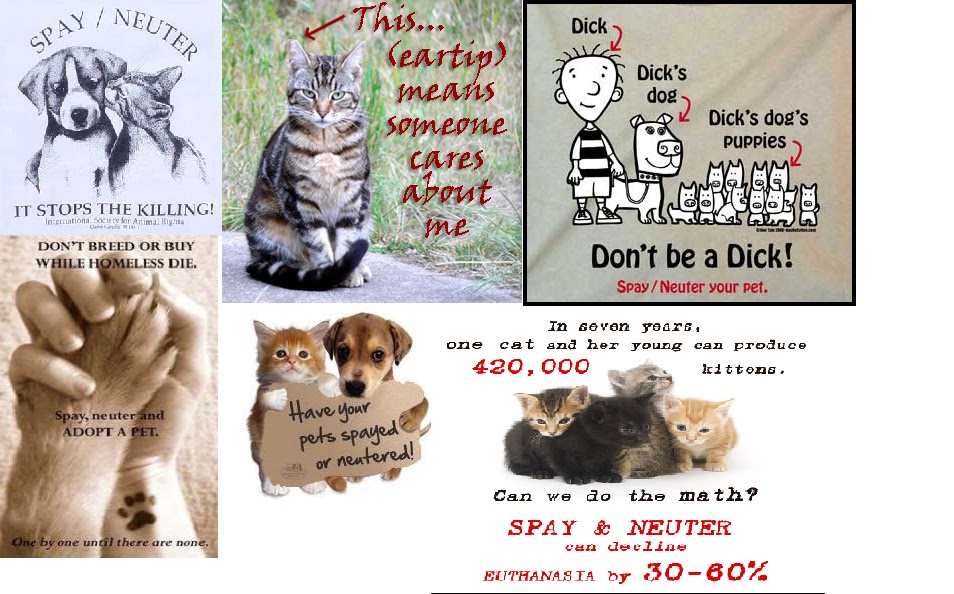
In the 80s and 90s, a huge movement took hold in America: the "Spay or Neuter Your Pet" movement. Thousands of clever, heart-wrenching and funny advertisements for spaying and neuring pets were broadcast via every media imageinable, by humane societies, vets and other do-gooders. The movement coincided with awareness of human over-population, environmental problems, lab animal testing concerns and government willingness to fund social programs.


Click to enlarge.

The results were fantastic. The number of animals euthanized in pounds across America dropped dramatically. There was less neglect. Vet clinics and the government chipped in to set up low-cost spay and neuter programs for those that had too little money or too many animals. To this day, in many places in the USA you can't have an un-neutered dog without getting some weird looks and curious (or nasty) comments. It's actually rather taboo to admit to breeding a litter or two of puppies. The cat and dogs populations are still larger than they should be, and 3-4 million dogs and cats are still euthanized yearly; but things are much better than they used to be..

Why wouldn't this work for horses?

At least, that had been my first thought.

Gelding: removing balls, adding brains.


There are several reasons why this solution is problematic:
  • you can't "spay" a mare without significant cost and risk; it's not as easy as spaying a cat
  • there would be less support for such a campaign, since there are fewer horse lovers, fewer horse vets, and not enough government support
  • low cost gelding clinics can only work if you can get a whole bunch of stallions in one place at one time-- otherwise it's not cost-efficient enough for a vet to want to do it. And that's hard.
    • safety risk
    • every horse would have to have a Coggins test and rabies vaccine first (cost, risk)
    • not everyone has a trailer
    • not every horse loads well
It doesn't mean that low-cost gelding clinics can't happen. They can, and have, successfully. Look here. And here. California is even launching a state-wide program. Low-cost euthanasia programs have also helped. However, these obstacles do prevent the kind of success we've seen with the dog and cat population problems.

So, what do YOU think? Is there a better solution than slaughter? What is it?


*For newbies to the horse slaughter debate:

Proponents of American horse slaughter say that when domestic horse slaughter was stopped five years ago, it had a negative affect on horses across the country. Since you couldn't even get a hundred or so bucks for a slaughter-bound horse at an auction any more, the bottom fell out of the horse market, devaluing even nice horses and devastating the horse industry in general. Proponents of horse slaughter also say that a lack of domestic slaughter facilities means more horses being left to starve, and those that do go to slaughter face long, awful journeys and more horrific deaths in Mexico and Canada. Finally, horse slaughter would help revive the stagnant economy, providing jobs to many.


Anti-horse-slaughter experts say that the number of horses slaughtered hasn't dropped-- so if there are extra horses being neglected, it's due to the poor economy and increased shipping costs to Mexico and Canada. Whether that's true or not, they argue, neglect was always an issue even when American slaughter plants operated; some nasty people will just mistreat animals no matter what, and building a slaughter plant in every state in America won't change that. The real solution, they say, is to stop over-breeding horses; reducing the population will drive up demand (and thus prices) and reduce cases of neglect. Slaughtering horses is not "American," they claim; no one here wants to eat the horses we care about. It's not humane to the easily-spooked, sensitive horses, and its not safe for consumers to be eating horses contaminated with Bute, steroids, etc.

American Horse Slaughter: Lies, Confusion and the Law


It's huge news: horse slaughter is back in America! Or is it? There's a ton of confusion, hype and spin going on-- so I'm here to give you the straight scoop.

What Everyone is Yelling About:
PETA says they support horse slaughter!

Is it True?
No-- but they sort of support the recently signed bill. PETA basically said that while they hate the idea of horse slaughter, they'd rather have horses killed here in the USA, semi-humanely, rather than on foreign soil, where they're more likely to die terribly. Ideally, says PETA, there should be a ban on slaughtering American horses domestically and overseas. You can read it "from the horse's mouth" here.

PETA: Making sexy and ridiculous comparisons since forever.


What Everyone is Yelling About:
President Obama signed a bill that makes horse slaughter legal in the USA. He supports horse slaughter! Slaughter plants will re-open within a few months!

Is It True?
Not really. Obama can't be blamed or credited for the possible comeback of U.S. horse slaughter.

First, Obama didn't sit down to approve horse slaughter specifically. The few lines about horse slaughter were packaged into H.R. 2112, the Fiscal Year 2012 Agriculture Appropriations Bill. This is a HUGE bill that gets passed every single year; it's a $125.5 billion dollar budget for the Departments of Agriculture, the Food and Drug Administration and a billion other big-name agencies. The House and Senate add stuff, negotiate, remove stuff, and pass it on to the President. It included everything from assigning funds to school lunch programs to prohibiting funds for the FDA to approve genetically engineered salmon. This is the same infamous bill, by the way, that made pizza sauce a "vegetable" in school lunch programs.

Lobbyists: On one hand, they influence laws to benefit corporations. On the other hand, pizza!!


Secondly, the president couldn't really veto the bill, even if he had wanted to. Doing so would be political suicide-- without a working budget, he'd basically shut down the FDA, school lunch assistance programs and other stuff that would have people screaming. Remember when there was so much debate about bills that Congress almost caused a government shut down and left American troops without pay? It would be like that. Also, vetoing it probably wouldn't work. While a president can veto any bill and send it back to Congress, Congress can vote to over-ride a presidential veto. This bill has enough bipartisan support to do that. By the way, when a president signs a bill, he has to sign all of it into law; he doesn't get to pick it apart and only sign off on the stuff he likes.


Finally, H.R. 2112 doesn't "make horse slaughter legal." It wasn't illegal in the first place. Five years ago, a law was passed defunding FDA inspections of horse slaughter plants. With no FDA inspections, slaughter plants closed because they could no longer legally sell to foreign markets, not because the government made horse slaughter itself illegal (except in California, where they did). H.R. 2112 said, "Okay, fine, it's now legal to fund FDA inspections of horse slaughter plants again." However, the bill didn't throw money at those inspections either; it just said it was legal to pay for them now. It will be up to lobbyists to try to get legislature passed to pay for these inspections. It will also be up to American businessmen and communities to decide if they even want to build or re-open slaughter plants in their area.


Whether you approve of horse slaughter or don't, whether you love Obama or hate him, the President didn't have much to do with the issues here. I'm not sure he even knows that there's a controversy. The few lines on horse slaughter inspections didn't even make it into an official summary of amendments to the bill, found here. I'm pretty sure if you saw the President in a bar and asked him about it, this is what would happen:


You:  "Mr. President, what were your reasons for legalizing horse slaughter in America?"
Obama:  "Um, what? Oh, that budget thing. Didn't read all of it. Signed it while flying through Asia, in fact."
You:    "But how do you feel about horse slaughter?"
Obama:   "Let me get an aide to do some fact checking. I'll get back to you. Gotta go, bye."


"Huh. People slaughter horses? I might look into that if I get the Iraq-Afghanistan-Libya-Healthcare stuff resolved."


P.S. If you're some sort of masochist, you can read the full H.R. 2112 bill here.

Saturday, November 5, 2011

Euthanize Me, Please!

Of all the things I hate in the horse world, failing to euthanize an old horse has got to be in the top 5.

After years of service, whether it was as a show horse, trail horse, broodmare or just a pet, an old horse whose time has come deserves a peaceful death. That horse deserves to die in a familiar place, among the people and animals it has bonded with. It deserves to die with dignity.

An old horse should NOT be given away free on Craigslist to the first kill-buyer to call, or total-idiot-who-wants-a-free-horse or a backyard breeder hoping for one more foal out of the poor thing.
An old horse should NOT be left laying in the pasture, unable to rise, for hours or days.
An old horse should NOT be forced to live months or years in poor condition, underweight and sick.

Here's another Craigslist ad that pissed me off today: Mr. (or Ms.) Jerk is dumping a "20 something" year old horse on Craigslist for free:


The owner doesn't bother to describe her health, what training she's had, how tall she is, if she's gentle, if she trailers well or accepts vet care and farrier work nicely, and they don't bother to post a picture. The owner doesn't include any details that make this horse attractive to a new owner. The best they can do is guess at an age and say she might possibly be rideable, but since they haven't bothered to do anything with her for the past four years, it's a crap shoot.

This owner might as well be screaming, "I don't care about this horse!! I just want to throw her away!! Somebody take her!!"

And someone probably will take her away. It will probably be a very nice, smiling man with a very big trailer. He'll say something like, "Oh yeah, the grandkids will love sitting on her back. Don't worry, she'll have a great home." Soon after that, the mare will end up in a Mexican slaughter house -- guaranteed.


YOU bought the horse, fed it, rode it, maybe bred or showed it-- YOU have a responsibility to care for it, and that includes ALL of it, including sickness and old age.

I don't understand how someone can keep a horse for years, paying for its board, feed and farrier care, vaccinations and even show fees, love it and pet it, but suddenly when it comes time to deal with a senior horse, they can't. Just can't handle it. How? Old age and death are literally the only unavoidable things on this planet-- and you failed to plan for them?

I think part of it is America's absolute refusal to deal with death. America is all about looking young-- we're obsessed with it, in fact. Anti-wrinkle cream, teeth whiteners, weight loss programs, hair transplants, face lifts, Botox-- it goes on and on. We don't even want to plan for our own old age and funeral, much less our animals' deaths. And relatives? Forget it! When a human relative gets too old, we ship them off to a nursing home, where we guiltily visit only as much as we can force ourselves to do so. In the hospital, we keep them alive with machines as long as we can, and agonize over the decision to unplug them from life support. When they die, we have them embalmed so that they look alive-but-sleeping, bury them in elaborately decorated coffins designed to delay decay as long as possible, and then rarely visit the graveyard.


~ Quote by Woody Allen


We don't like to be reminded of death-- and euthanasia can be downright painful. We'll do practically anything to put it off or deny its necessity. I have known some wonderful, kind, intelligent people who have waited days, months or years to put down horses, when those horses clearly had very poor quality of life.
It's very, very hard to euthanize an animal you've known and loved. Not only is that animal dying and leaving your life forever, you're the one that arranges it. You may know you're doing the right thing, but it still feels awful to be the one holding the leadrope when the horse goes down. It feels terrible to have to think I made this happen. I know because I euthanized my first horse, good old Joe, in 2007. He was in his late 20s. I cried and cried.

Joe -- RIP 9/19/2007

BUT.

I know he died happy. He died in his own pasture, surrounded by friends. He had treats and lots of love before he went, and he never felt a thing-- never even anticipated anything weird. He was grazing right up until about a minute before his death. Then he took one big, deep breath-- and went down.

That's the kind of death I want for all of my animals, and for myself too. Quick, painless, happy, no anticipation or fear. No lingering, painful health issues, no dementia, no adult diapers. In fact, it would be nice if someone shot me in the back of my head, without my knowing it, sometime very shortly after I've reached senility. 

I think it helps to be around death a little more, so that you know what to expect. When we know more, we fear a little less. If you think it might help, here's a very short video of an old, blind mare being euthanized. She takes less than a minute to die, goes very peacefully, and is literally dead before she gently falls over. She's not a bit afraid, going to her rest in a big green field while being petted by a volunteer at NorCal Equine Rescue, a horse rescue that specializes in low-cost euthanasia clinics for low-income horse owners. Here you go:


 Nice, wasn't it? Makes me sniffle a bit, but that's the right way to treat an old friend whose time has come.

I get so angry at people dumping old horses on Craigslist, that sometimes I actually respond to the ad and beg them to euthanize their poor old horse. I got this lovely response from one gentleman trying to get rid of an ancient, unsound, unrideable mare:

"We have already considered your concerns. We DO NOT intend on letting her go to a 'kill' buyer. We have had horses for more than 30 years and we do know who the kill buyers are. We had hoped that some one would be willing to give her a nice place to live out her life instead of just putting her down. That is our last option. To choose to be God over any animal isn't doing it right it only justifies your decision to destroy it instead of letting it live on with some one else. That is what is fair to the animal."

 What absolute blindness. First of all, there's just no way that you're going to know every kill buyer who comes calling. This is particularly true when you post on Craigslist. People from all over the place respond. Secondly, somehow, this guy convinced himself that dumping his ancient mare on Craigslist like a piece of trash was more "fair" than giving her a peaceful death. He also managed to convince himself that somehow, owning, riding, feeding, vetting and in general keeping an animal in captivity was not "playing God," but euthanasia is, and is immoral or "unfair." Crappy, crappy jerk.

However, I can almost sympathize with that guy, and others like him who manage to convince themselves that their fear of euthanasia/death is actually a moral stance. They're irresponsible, and blind to their own true motives, but their intentions are basically good. They really do desperately hope that somebody will want their crippled, unrideable old mare, will give her a wonderful, loving new home, and she'll someday lay down and die instantly (in that someone else's pasture).

No, what really makes me angry are people who don't really have a problem with euthanasia-- but they just don't want to pay for it. Those people are beneath contempt.

I understand that some people are in desperate circumstances. Money might be tight, health issues play a role, some people are losing their homes-- but just because you're suffering doesn't give you a right to inflict suffering on your horse. If nothing else, a bullet to the head is more kind to an old horse than an uncertain future in the hands of total strangers. At least the bullet is quick and sure-- you KNOW that horse died well, and died happy. A bullet doesn't cost much, and if you can't borrow a gun or a willing gunman, you must not be living in America. You can also see if there's a low-cost euthanasia clinic in your area; while not common, they do exist.

Disposal-- yes, it's hard. It can cost several hundred dollars to dispose of a horse's corpse. However, if you're in a boarding situation, you can apply the money you would have used to pay for the horse's board towards disposal. If you shot the horse in the head or used a captive bolt gun to euthanize it (rather than with chemicals), you might be able to get a local big cat sanctuary to take the carcass for meat-- and even the Amish will sometimes take a dead horse for dog meat. (Yes, it's gruesome, but much less so than a trip to a Mexican slaughter house. At this point, the horse is dead and does not care.) If you own your own land, it's often legal to bury the horse in its own pasture-- which is what I was able to do with my first horse, good old Joe. Don't have a backhoe? Grab a shovel. Start digging. Beg friends to help. Do what you need to do.

Still not convinced? Still thinking about dumping your horse on Craigslist for free, or sending it to an auction with no minimum price request? Here's what awaits: a truly horrifying trip to a Mexican slaughterhouse, where horses are gutted while alive. Check out the video below for details. WARNING: GRAPHIC