Showing posts with label neuter. Show all posts

Wednesday, September 5, 2012

Richland Center Rescues: sketchy RAR vs quality Ocooch

First, a few brief news bulletins.

Another case of EEE was confirmed in Wisconsin. Remember to vaccinate!

A Dane County judge has ruled that dogs cannot be used to hunt wolves in Wisconsin. The DNR will uphold the ruling, but hasn't re-written any rules yet, and is planning on going ahead with the wolf hunt in October.

There was a neat article for horse lovers and Packer fans alike in a Milwaukee paper recently; click here to read it.
 
Now then, on to the part where I rant:

Richland Area Rescue worries me. Nay, angers me.

Although they don't appear to be actively breeding animals, their behavior raises several red flags.

-Not all animals are spayed/neutered/gelded
-Not all animals appear to have basic vaccinations

-Until recently, the kennels were primitive, with dirt floors
-Some animals don't have minimal basic training
...and other sketchy stuff.

Let me give you an example. I was tipped off about RAR when a watchful horse rescuer emailed this Petfinder ad to me:

https://mail-attachment.googleusercontent.com/attachment/?ui=2&ik=68e1d9545a&view=att&th=1399361a8616641d&attid=0.1&disp=inline&realattid=f_h6pkdbn80&safe=1&zw&saduie=AG9B_P-AyQEAMKEBfD5YP6r4qYbz&sadet=1346876529229&sads=9MPgzSSu9gFbB8EvU3fEUdslo5Q&sadssc=1
Click to enlarge


1) Why is this pony not gelded?! Especially when they admit "he should be gelded?!" RAR, you're a rescue, do your damn job!

2) He's been "sat on" but "isn't broke." Okay, who sat on an unbroke mini? A kid? Great, awesome child endangerment. An adult? Awesome, great way to permanently damage an animal. Let's skip straight past my usual argument of "two year old horses should NOT be made to carry weight," and go on to a rant about minis and "being broke."

Minis aren't really meant to be ridden. Like pot-bellied pigs, their main purpose is to look adorable and possibly to pull tiny carts. Can they be ridden? Sure. But they probably shouldn't be. Unless you have a midget volunteer, you're either breaking a horse to ride with a child as its trainer/rider, OR you're using the crushing weight of an adult. Either way, you suck. Are there ways to train a mini without endangering a child or squishing said equine? Well... yes. Effective ones? Ehhh.... maybe. That's a debate for another time.

Let's take a look at some other sketchy stuff at RAR:

This horse isn't guaranteed sound-- she has problems in her whole back end. RAR doesn't know what's wrong with her, because apparently they don't want to pay a real vet to find out, but after a cursory look from a vet tech, they guess she'll be okay for light riding with a light rider. This sounds totally safe.

This mare looks a bit too ribby in her pictures, and her colt is 5 months old, but  "hasn't had anything done with him." Yikes, when do they plant to start halter breaking? When he's big enough to really hurt someone?

Emilita and Prince: Arabian, Horse; Richland Center, WI


This pony is unbroke, but is being advertised as, "she could make a great birthday present for a little kid." I shall now repeat the obligatory mantra: "Animals should not be given as presents." Shouldn't a rescue know not to use this as a selling point?

...and there not-fixed puppies up for adoption without all their shots, unclear adoption prices, no mention of a return-to-shelter requirement when a pet doesn't work out, etc etc.

I think the argument could be made that I'm mostly nit-picking here. By themselves, each of these complaints might be petty. And even put together, they don't add up to actual abuse. It might be a little rough-and-ready, back-woods, poor quality type of rescue, but they're trying, right? And there are certainly camps of people who believe that rescues who help many animals a little are just as good as rescues who help a few animals a lot.

However, I cannot and will not forgive any "rescue" or "shelter" for not spaying/neutering/gelding animals in their care. Animals wind up in shelters because they are unwanted. How do we have unwanted animals? Largely, because we've allowed too many of them to breed.And sending an unfixed animal out the door is an invitation for it to breed.

Richland Area Rescue does say, "We are working towards having all dogs and cats spayed and or neutered before adoption." They also have a one-page contract, part of which states that any animal adopted needs to be spayed/neutered/gelded within 30 days of adoption. But to me, these are flimsy mechanisms. RAR should just act responsibly, dammit.

Interestingly, there is another rescue in Richland Center: Ocooch Mountain Humane Society. They have a much nicer website, a bimonthly low-cost spay-and-neuter program, regular fundraising events, a much more thorough adoption application, and all their animals are fixed and have all their shots. Ocooch is still small; they only have a facility for cats (dogs are all privately fostered) but you can tell there have a quality operation.

So why is it that RAR has gotten the Richland County contract to take in strays, not the better-run Ocooch? I'm guessing RAR underbid Ocooch for the contract. That's a shame. If you're from the Richland Center area, please take a moment to tell your city government to spend your tax dollars at a higher quality facility that really cares for animals. (Click the link and then scroll down for contact info for city officials.)

I contacted Ocooch to ask them about the county contract as well as their operation versus RAR's, but didn't hear back by press time*.

*Update: never ever heard back from them.


Thursday, December 8, 2011

Horse Slaughter-- Is There Another Solution?


I hate the idea of horse slaughter. 
I also can't come up with another solution.

I don't want to hash out the whole horse slaughter debate here. Most people know the main points of both sides already. If you haven't participated in at least one vicious discussion about horse slaughter, you're either new to the horse world or new to the internet. In that case, find a summary at the bottom* of this post. What I'd really like to talk about today is finding a better solution.

Few people want horses to go to slaughter. Even those that support horse slaughter usually don't want their own horses to go through that hell. But how else do you solve the problems of over-population, unwanted racehorses, and a failing horse market?

What we should be doing, of course, is The Right Thing: not over-breeding, not keeping animals we can't afford, and taking responsibility for our senior and injured horses by paying for peaceful euthanasia instead of trying to make a little cash at the auction. I have yelled and ranted and raved about this all over the internet. Doing The Right Thing, however, is something you can't make people do.

 So what kind of programs could we create to cut back the need for horse slaughter?

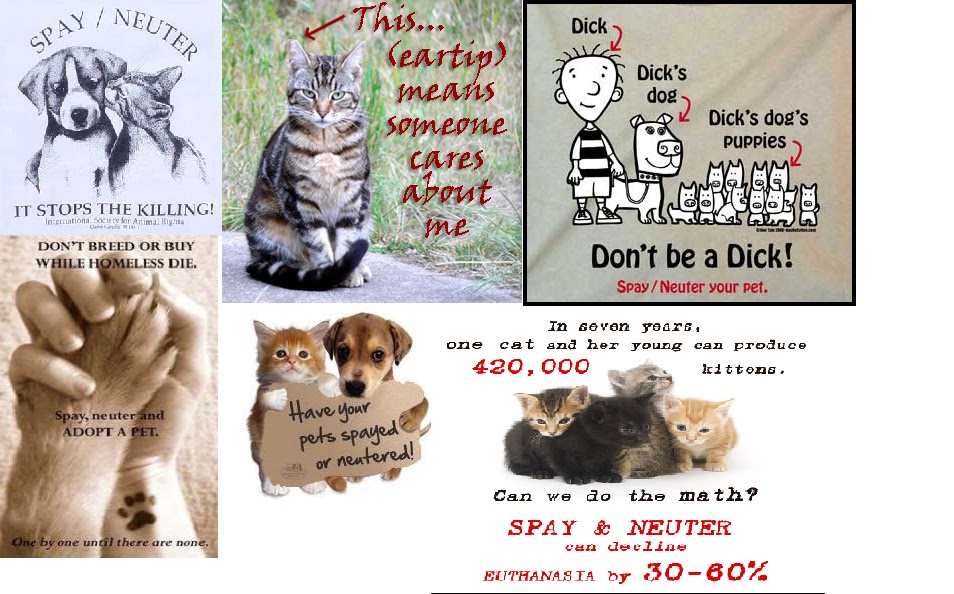
In the 80s and 90s, a huge movement took hold in America: the "Spay or Neuter Your Pet" movement. Thousands of clever, heart-wrenching and funny advertisements for spaying and neuring pets were broadcast via every media imageinable, by humane societies, vets and other do-gooders. The movement coincided with awareness of human over-population, environmental problems, lab animal testing concerns and government willingness to fund social programs.


Click to enlarge.

The results were fantastic. The number of animals euthanized in pounds across America dropped dramatically. There was less neglect. Vet clinics and the government chipped in to set up low-cost spay and neuter programs for those that had too little money or too many animals. To this day, in many places in the USA you can't have an un-neutered dog without getting some weird looks and curious (or nasty) comments. It's actually rather taboo to admit to breeding a litter or two of puppies. The cat and dogs populations are still larger than they should be, and 3-4 million dogs and cats are still euthanized yearly; but things are much better than they used to be..

Why wouldn't this work for horses?

At least, that had been my first thought.

Gelding: removing balls, adding brains.


There are several reasons why this solution is problematic:
  • you can't "spay" a mare without significant cost and risk; it's not as easy as spaying a cat
  • there would be less support for such a campaign, since there are fewer horse lovers, fewer horse vets, and not enough government support
  • low cost gelding clinics can only work if you can get a whole bunch of stallions in one place at one time-- otherwise it's not cost-efficient enough for a vet to want to do it. And that's hard.
    • safety risk
    • every horse would have to have a Coggins test and rabies vaccine first (cost, risk)
    • not everyone has a trailer
    • not every horse loads well
It doesn't mean that low-cost gelding clinics can't happen. They can, and have, successfully. Look here. And here. California is even launching a state-wide program. Low-cost euthanasia programs have also helped. However, these obstacles do prevent the kind of success we've seen with the dog and cat population problems.

So, what do YOU think? Is there a better solution than slaughter? What is it?


*For newbies to the horse slaughter debate:

Proponents of American horse slaughter say that when domestic horse slaughter was stopped five years ago, it had a negative affect on horses across the country. Since you couldn't even get a hundred or so bucks for a slaughter-bound horse at an auction any more, the bottom fell out of the horse market, devaluing even nice horses and devastating the horse industry in general. Proponents of horse slaughter also say that a lack of domestic slaughter facilities means more horses being left to starve, and those that do go to slaughter face long, awful journeys and more horrific deaths in Mexico and Canada. Finally, horse slaughter would help revive the stagnant economy, providing jobs to many.


Anti-horse-slaughter experts say that the number of horses slaughtered hasn't dropped-- so if there are extra horses being neglected, it's due to the poor economy and increased shipping costs to Mexico and Canada. Whether that's true or not, they argue, neglect was always an issue even when American slaughter plants operated; some nasty people will just mistreat animals no matter what, and building a slaughter plant in every state in America won't change that. The real solution, they say, is to stop over-breeding horses; reducing the population will drive up demand (and thus prices) and reduce cases of neglect. Slaughtering horses is not "American," they claim; no one here wants to eat the horses we care about. It's not humane to the easily-spooked, sensitive horses, and its not safe for consumers to be eating horses contaminated with Bute, steroids, etc.