Showing posts with label euthanasia. Show all posts

Friday, September 14, 2012

UW Madison, Horses for Science & Cat Experiments

Some of you may have a little orange sticker on your driver's license. You've made the decision to donate your organs after your death, in order to save lives or advance scientific knowledge. But what about something as near and dear to you as your own heart-- your horse?

http://www.vetmed.wisc.edu/images/news/endo.jpgJust like doctors, veterinarians need hands-on experience with patients in order to become better at treating them. Dissecting cadavers, human and animal, is a great way to get that experience. For one, there are no consequences if a student slips up with a scalpel. But how does the donation process work?

I spoke with Simon Peek, a professor at the University of Wisconsin Madison, School of Veterinary Sciences, to find out more. Professor Peek has an impressive list of credentials, and an impressively smooth British accent to match. He graduated from Cornell University with the PhD, has co-authored at least two books, and is an expert in things I cannot even pronounce, let alone comprehend. (Theriogenology-- uh, Thare-eeeeooh-ge... yeah, whatever that is.) Did I mention the accent? Very dreamy. That's him there --------->

Professor Peek says that UWSVM takes in less than twenty horses per year, though that number can vary greatly based on the needs of the school. Some horses, usually old or ill, are euthanized almost immediately after being donated, then used for practice surgeries, disease study and dissection. The school is largely interested in accepting donated horses in this category, especially ones with unusual deformities, advanced diseases and other problems, since they are most valuable in teaching students. A few horses, mostly mares, are kept as practice patients for vet students to hone their skills on. Peek is quick to clarify that these procedures are all routine and painless (taking pulses and temperatures, doing ultrasounds, etc). Most rarely of all, according to Peek, is that a healthy horse might be used in "research," i.e. used in experiments.

Peek is wary about this topic, since the recent controversy over cat experiments at the University. He declined to comment on that subject over the phone, except to say that it's making everyone nervous (we'll get back to it in a bit). As for horses, Peek himself is not performing any horse research at the moment, and is unaware of any colleagues that are. He also wanted to emphasize that, "the [school's] first commitment is to the horse." No ill or injured horses are kept that way for study-- they are treated or euthanized immediately.

Speaking of euthanasia, Peek says that all too often, people seeking a cheap way out ask about donating their old horses rather than paying for the cost of euthanasia and burial themselves. "We don't do that," he says. UWSVM is not a good resource for those looking for free assistance. In fact, Peek rather ashamedly goes on to admit that the Vet School is so pressured by "budgetary woes," that, when a horse is accepted for donation, "although we feel extremely self-conscious in doing so, particularly because this is such an emotional time, and people are donating their animal, we usually ask for a monetary donation to help cover our costs." He says that this varies case by case, but usually runs about $200 (still much less than the cost of euthanasia by your regular vet and rendering).

So what do you do if you are interested in donating your horse to the vets for the betterment of human and equine alike? Professor Peek says the process is, "rather ad hoc." You should contact the large animal desk at UWSVM, and eventually someone will talk to you about your horse, what you are willing or not willing to have done to it, and the possibility of donation. Don't get them wrong, they are very grateful for donations-- it's just that they can't afford take every horse offered. Be sure to have all the past vet records for the horse on hand.

I was very appreciative of Dr. Peek's willingness to talk to me, a lowly internet nobody, about these issues. I just wish his colleagues over at the University were a little more forthcoming.

It's the actual University of Madison, not the Vet School, that has been conducting experiments on animals.Though the difference may seem academic, I believe it's important. A good veterinarian upholds the same ideals as a doctor-- first, do no harm. The patient is most important, not the success or failure of a procedure. Researchers, however, operate under a different ideology. Though most researchers are not purposefully cruel to animals in research (simply because doing so might skew the test results) neither are they particularly concerned about an animal as an individual.

Let's back up a second. If you've been living with your head under a rock, you may not know that PETA has accused UW Madison of cruelty on and off for decades because they conduct animal experiments. Some of it is probably justified (decompression experiments on sheep) and some of it probably isn't (milking a cow is not like rape). Most recently, PETA has caused an uproar about a cat named Double Trouble (article here). Double Trouble was used in experiments involving cochlear implants, devices which allow deaf people to hear. They wanted to know more about how the brain locates the origin of a sound. During the experiments, they did some fairly gruesome things, though all with pain medication and all within the limits of the law. PETA, however, has provided some pretty convincing evidence that these cats, Double Trouble especially, suffered. More pictures here (warning: pretty awful).


PETA got these pictures, and the evidence for the cats' suffering, from the UW's own records by legally requesting them via a nice little law that says government funded places have to reveal everything they do.

Now, I usually hate PETA, and I'm not necessarily against animal experimentation (except for experiments on primates-- go fuck yourselves on that one, scientists. And couldn't we just use convicted child molesters for everything instead?). We've used animals to develop pretty much every vaccine, heart implant, life-saving medication and complex surgical procedure known to man, benefits I've reaped myself. Were it not for animal experiments, I'd be a half-blind, one-armed crazy woman with constant ear infections and six kids. And there's just no way around it-- we still need animals (or criminals) to develop more of that stuff. No matter what the idealists would have you believe, a computer will never be a substitute for a living organism. However, I have several problems with this particular crap:

1) It does seem like there was unnecessary suffering in this case.

2) We don't know that this research was in any way important. UW Madison has passed it off as "cochlear implant research." Uh, we have those available to the public already, they work great. What's this really about? Because if it's building a better war machine, or research for the sake of research.... ugh.

3) Why don't they talk to us?

 Professor Peek, a pretty important guy, was cool enough to walk me through the ins and outs of donating horses to the UW Vet School. He even talked about some of the controversial stuff, like asking for money from horse owners, experiments on horses and using live horses as practice patients. He was willing to talk about things he was slightly embarrassed about, to a random person on the phone, in a way that made sense. But the best that the University can do is issue a statement that basically says, "We didn't do anything wrong."

Listen up UWMad. I'm willing to be on your side in this, but not if you act like a shady motherfucker. Talk to us. Tell us, in plain English, what these experiments are really about, why you believe the suffering of these cats was justified, what you did wrong, and how you can do better. Nothing says "guilty" to me like clamming up. I understand if you aren't allowed to talk specifically about the research because it involves patented techniques or whatever, but tell us that, then do your best to explain without revealing any tech secrets. It's not hard, we don't need the technical stuff!

I'm sure PETA and other hard-liners would blame UW Mad no matter what, but for the average Joe, a little explanation would go a long way. Without that explanation, I'm forced to err on the side of PETA. And Lord, do I hate doing that. One of the reasons Professor Peek and his colleagues are nervous is that PETA likes to throw around fake blood, harass vets and scientists, and fund terrorist groups like ALF that attack people and burn down buildings. But that's an expletive-filled post for another time.

http://nshima.typepad.com/photos/uncategorized/2007/12/13/gotpus.jpg?w=300&h=300http://ficdn.fashionindie.com/wp-content/uploads/2009/01/0228_peta_protest_getty_21.jpg
...fucking lying shock-jock hypocrites.


Thursday, December 8, 2011

Horse Slaughter-- Is There Another Solution?


I hate the idea of horse slaughter. 
I also can't come up with another solution.

I don't want to hash out the whole horse slaughter debate here. Most people know the main points of both sides already. If you haven't participated in at least one vicious discussion about horse slaughter, you're either new to the horse world or new to the internet. In that case, find a summary at the bottom* of this post. What I'd really like to talk about today is finding a better solution.

Few people want horses to go to slaughter. Even those that support horse slaughter usually don't want their own horses to go through that hell. But how else do you solve the problems of over-population, unwanted racehorses, and a failing horse market?

What we should be doing, of course, is The Right Thing: not over-breeding, not keeping animals we can't afford, and taking responsibility for our senior and injured horses by paying for peaceful euthanasia instead of trying to make a little cash at the auction. I have yelled and ranted and raved about this all over the internet. Doing The Right Thing, however, is something you can't make people do.

 So what kind of programs could we create to cut back the need for horse slaughter?

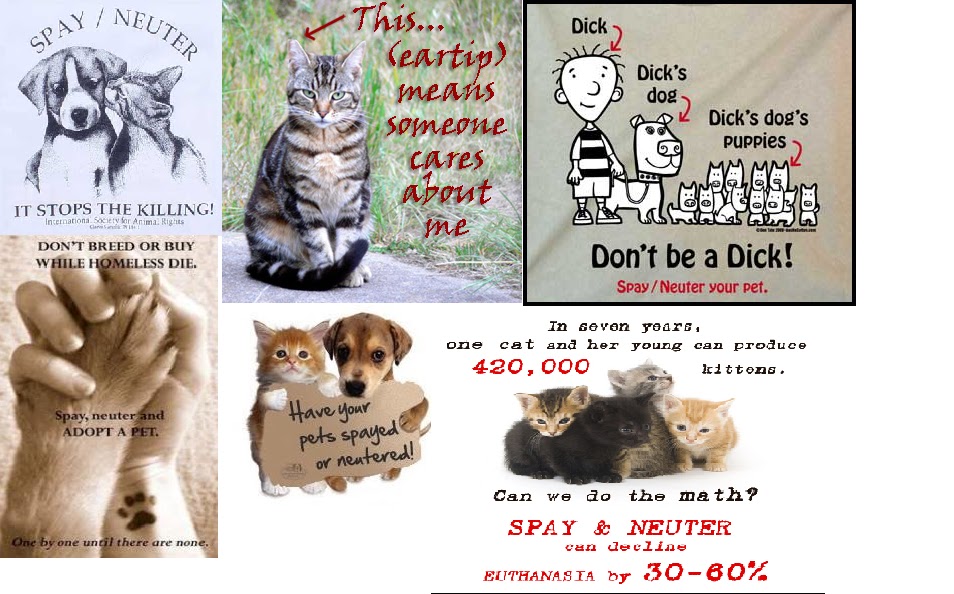
In the 80s and 90s, a huge movement took hold in America: the "Spay or Neuter Your Pet" movement. Thousands of clever, heart-wrenching and funny advertisements for spaying and neuring pets were broadcast via every media imageinable, by humane societies, vets and other do-gooders. The movement coincided with awareness of human over-population, environmental problems, lab animal testing concerns and government willingness to fund social programs.


Click to enlarge.

The results were fantastic. The number of animals euthanized in pounds across America dropped dramatically. There was less neglect. Vet clinics and the government chipped in to set up low-cost spay and neuter programs for those that had too little money or too many animals. To this day, in many places in the USA you can't have an un-neutered dog without getting some weird looks and curious (or nasty) comments. It's actually rather taboo to admit to breeding a litter or two of puppies. The cat and dogs populations are still larger than they should be, and 3-4 million dogs and cats are still euthanized yearly; but things are much better than they used to be..

Why wouldn't this work for horses?

At least, that had been my first thought.

Gelding: removing balls, adding brains.


There are several reasons why this solution is problematic:
  • you can't "spay" a mare without significant cost and risk; it's not as easy as spaying a cat
  • there would be less support for such a campaign, since there are fewer horse lovers, fewer horse vets, and not enough government support
  • low cost gelding clinics can only work if you can get a whole bunch of stallions in one place at one time-- otherwise it's not cost-efficient enough for a vet to want to do it. And that's hard.
    • safety risk
    • every horse would have to have a Coggins test and rabies vaccine first (cost, risk)
    • not everyone has a trailer
    • not every horse loads well
It doesn't mean that low-cost gelding clinics can't happen. They can, and have, successfully. Look here. And here. California is even launching a state-wide program. Low-cost euthanasia programs have also helped. However, these obstacles do prevent the kind of success we've seen with the dog and cat population problems.

So, what do YOU think? Is there a better solution than slaughter? What is it?


*For newbies to the horse slaughter debate:

Proponents of American horse slaughter say that when domestic horse slaughter was stopped five years ago, it had a negative affect on horses across the country. Since you couldn't even get a hundred or so bucks for a slaughter-bound horse at an auction any more, the bottom fell out of the horse market, devaluing even nice horses and devastating the horse industry in general. Proponents of horse slaughter also say that a lack of domestic slaughter facilities means more horses being left to starve, and those that do go to slaughter face long, awful journeys and more horrific deaths in Mexico and Canada. Finally, horse slaughter would help revive the stagnant economy, providing jobs to many.


Anti-horse-slaughter experts say that the number of horses slaughtered hasn't dropped-- so if there are extra horses being neglected, it's due to the poor economy and increased shipping costs to Mexico and Canada. Whether that's true or not, they argue, neglect was always an issue even when American slaughter plants operated; some nasty people will just mistreat animals no matter what, and building a slaughter plant in every state in America won't change that. The real solution, they say, is to stop over-breeding horses; reducing the population will drive up demand (and thus prices) and reduce cases of neglect. Slaughtering horses is not "American," they claim; no one here wants to eat the horses we care about. It's not humane to the easily-spooked, sensitive horses, and its not safe for consumers to be eating horses contaminated with Bute, steroids, etc.

Saturday, November 5, 2011

Euthanize Me, Please!

Of all the things I hate in the horse world, failing to euthanize an old horse has got to be in the top 5.

After years of service, whether it was as a show horse, trail horse, broodmare or just a pet, an old horse whose time has come deserves a peaceful death. That horse deserves to die in a familiar place, among the people and animals it has bonded with. It deserves to die with dignity.

An old horse should NOT be given away free on Craigslist to the first kill-buyer to call, or total-idiot-who-wants-a-free-horse or a backyard breeder hoping for one more foal out of the poor thing.
An old horse should NOT be left laying in the pasture, unable to rise, for hours or days.
An old horse should NOT be forced to live months or years in poor condition, underweight and sick.

Here's another Craigslist ad that pissed me off today: Mr. (or Ms.) Jerk is dumping a "20 something" year old horse on Craigslist for free:


The owner doesn't bother to describe her health, what training she's had, how tall she is, if she's gentle, if she trailers well or accepts vet care and farrier work nicely, and they don't bother to post a picture. The owner doesn't include any details that make this horse attractive to a new owner. The best they can do is guess at an age and say she might possibly be rideable, but since they haven't bothered to do anything with her for the past four years, it's a crap shoot.

This owner might as well be screaming, "I don't care about this horse!! I just want to throw her away!! Somebody take her!!"

And someone probably will take her away. It will probably be a very nice, smiling man with a very big trailer. He'll say something like, "Oh yeah, the grandkids will love sitting on her back. Don't worry, she'll have a great home." Soon after that, the mare will end up in a Mexican slaughter house -- guaranteed.


YOU bought the horse, fed it, rode it, maybe bred or showed it-- YOU have a responsibility to care for it, and that includes ALL of it, including sickness and old age.

I don't understand how someone can keep a horse for years, paying for its board, feed and farrier care, vaccinations and even show fees, love it and pet it, but suddenly when it comes time to deal with a senior horse, they can't. Just can't handle it. How? Old age and death are literally the only unavoidable things on this planet-- and you failed to plan for them?

I think part of it is America's absolute refusal to deal with death. America is all about looking young-- we're obsessed with it, in fact. Anti-wrinkle cream, teeth whiteners, weight loss programs, hair transplants, face lifts, Botox-- it goes on and on. We don't even want to plan for our own old age and funeral, much less our animals' deaths. And relatives? Forget it! When a human relative gets too old, we ship them off to a nursing home, where we guiltily visit only as much as we can force ourselves to do so. In the hospital, we keep them alive with machines as long as we can, and agonize over the decision to unplug them from life support. When they die, we have them embalmed so that they look alive-but-sleeping, bury them in elaborately decorated coffins designed to delay decay as long as possible, and then rarely visit the graveyard.


~ Quote by Woody Allen


We don't like to be reminded of death-- and euthanasia can be downright painful. We'll do practically anything to put it off or deny its necessity. I have known some wonderful, kind, intelligent people who have waited days, months or years to put down horses, when those horses clearly had very poor quality of life.
It's very, very hard to euthanize an animal you've known and loved. Not only is that animal dying and leaving your life forever, you're the one that arranges it. You may know you're doing the right thing, but it still feels awful to be the one holding the leadrope when the horse goes down. It feels terrible to have to think I made this happen. I know because I euthanized my first horse, good old Joe, in 2007. He was in his late 20s. I cried and cried.

Joe -- RIP 9/19/2007

BUT.

I know he died happy. He died in his own pasture, surrounded by friends. He had treats and lots of love before he went, and he never felt a thing-- never even anticipated anything weird. He was grazing right up until about a minute before his death. Then he took one big, deep breath-- and went down.

That's the kind of death I want for all of my animals, and for myself too. Quick, painless, happy, no anticipation or fear. No lingering, painful health issues, no dementia, no adult diapers. In fact, it would be nice if someone shot me in the back of my head, without my knowing it, sometime very shortly after I've reached senility. 

I think it helps to be around death a little more, so that you know what to expect. When we know more, we fear a little less. If you think it might help, here's a very short video of an old, blind mare being euthanized. She takes less than a minute to die, goes very peacefully, and is literally dead before she gently falls over. She's not a bit afraid, going to her rest in a big green field while being petted by a volunteer at NorCal Equine Rescue, a horse rescue that specializes in low-cost euthanasia clinics for low-income horse owners. Here you go:


 Nice, wasn't it? Makes me sniffle a bit, but that's the right way to treat an old friend whose time has come.

I get so angry at people dumping old horses on Craigslist, that sometimes I actually respond to the ad and beg them to euthanize their poor old horse. I got this lovely response from one gentleman trying to get rid of an ancient, unsound, unrideable mare:

"We have already considered your concerns. We DO NOT intend on letting her go to a 'kill' buyer. We have had horses for more than 30 years and we do know who the kill buyers are. We had hoped that some one would be willing to give her a nice place to live out her life instead of just putting her down. That is our last option. To choose to be God over any animal isn't doing it right it only justifies your decision to destroy it instead of letting it live on with some one else. That is what is fair to the animal."

 What absolute blindness. First of all, there's just no way that you're going to know every kill buyer who comes calling. This is particularly true when you post on Craigslist. People from all over the place respond. Secondly, somehow, this guy convinced himself that dumping his ancient mare on Craigslist like a piece of trash was more "fair" than giving her a peaceful death. He also managed to convince himself that somehow, owning, riding, feeding, vetting and in general keeping an animal in captivity was not "playing God," but euthanasia is, and is immoral or "unfair." Crappy, crappy jerk.

However, I can almost sympathize with that guy, and others like him who manage to convince themselves that their fear of euthanasia/death is actually a moral stance. They're irresponsible, and blind to their own true motives, but their intentions are basically good. They really do desperately hope that somebody will want their crippled, unrideable old mare, will give her a wonderful, loving new home, and she'll someday lay down and die instantly (in that someone else's pasture).

No, what really makes me angry are people who don't really have a problem with euthanasia-- but they just don't want to pay for it. Those people are beneath contempt.

I understand that some people are in desperate circumstances. Money might be tight, health issues play a role, some people are losing their homes-- but just because you're suffering doesn't give you a right to inflict suffering on your horse. If nothing else, a bullet to the head is more kind to an old horse than an uncertain future in the hands of total strangers. At least the bullet is quick and sure-- you KNOW that horse died well, and died happy. A bullet doesn't cost much, and if you can't borrow a gun or a willing gunman, you must not be living in America. You can also see if there's a low-cost euthanasia clinic in your area; while not common, they do exist.

Disposal-- yes, it's hard. It can cost several hundred dollars to dispose of a horse's corpse. However, if you're in a boarding situation, you can apply the money you would have used to pay for the horse's board towards disposal. If you shot the horse in the head or used a captive bolt gun to euthanize it (rather than with chemicals), you might be able to get a local big cat sanctuary to take the carcass for meat-- and even the Amish will sometimes take a dead horse for dog meat. (Yes, it's gruesome, but much less so than a trip to a Mexican slaughter house. At this point, the horse is dead and does not care.) If you own your own land, it's often legal to bury the horse in its own pasture-- which is what I was able to do with my first horse, good old Joe. Don't have a backhoe? Grab a shovel. Start digging. Beg friends to help. Do what you need to do.

Still not convinced? Still thinking about dumping your horse on Craigslist for free, or sending it to an auction with no minimum price request? Here's what awaits: a truly horrifying trip to a Mexican slaughterhouse, where horses are gutted while alive. Check out the video below for details. WARNING: GRAPHIC