Thursday, June 21, 2012

Poisonous Pasture Plants Part 2


You might remember my last blog about poisonous pasture plants. It's time for Part 2, where I'll show you how this spring's nasty weeds have grown, and which newly grown ones you need to worry about. Again, I'll only be showing you a select few- northern/midwestern plants that directly affect you or your horses. Most of these photos were taken directly from my pasture, so you know exactly what they look like right now. For further reading, visit your local library or try these helpful weed-identifiers from CA and WI.

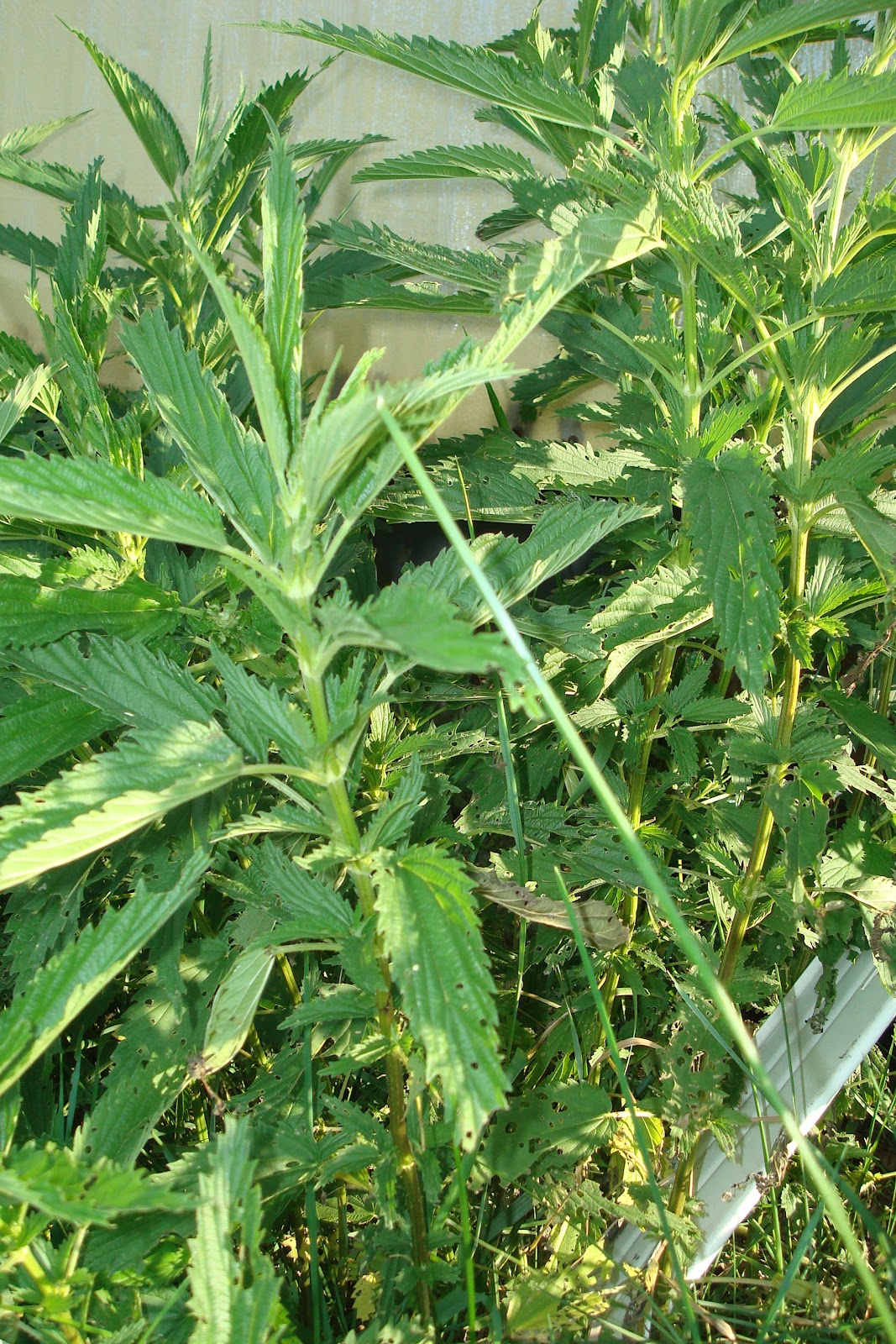
Nettles


They sting badly, leaving red itchy skin, but aren't poisonous. There are lots of kinds of nettles, but they all have darkish green leaves arranged in a "plus sign" shape, and the "toothy" edges of the leaves are spiky, not rounded. Evil, evil nettles! In the spring, they were sort of cute, and I even gave you a recipe for using the young plants in soups, etc. Now, however, the nettles are waist-high in places, and are more likely to cause skin rashes. Wear gloves when you're getting rid of them. If you come into contact with nettles, take an anti-histamine, soak your skin in cold water, then apply an anti-itch cream. Some horses are more affected by nettles than others-- better safe than sorry.


Wild Parsnip

WARNING: DANGEROUS! These weren't around much in spring, but now they're out in force. They look a lot like bigger, yellow versions of Queen Anne's Lace. Wild parsnip practices a horrific type of chemical warfare. Break any part of the stems, and the sap inside will react with the sunlight, causing burning, blistering and scarring on you OR your horse within 24 hours. Remove these with extreme caution by chopping them off at the root, below ground. Burning won't kill them. Chopping the stems often just spreads and sprays the sap onto you and the ground, and the plant grows back anyway.


If you or your horse is gets wild parsnip sap on you, IMMEDIATELY cover up the affected area and keep it covered for at least three days. The more the sap is exposed to daylight, the worse it's going to be. In a dark area, wash the skin with soap and water to try to remove as much sap as possible. From then on, there's not much you can do except live with the agony. Full recovery can take months. This is an excellent fact sheet, and has a lot more photographs.


Burdock

Annoying, but not poisonous (you can even eat the young leaves). This is the stuff that eventually spawns those awful prickly balls that stick to your horse, saddle blanket, dog, clothes, and everything else. They actually inspired the invention of velcro. At this point in the summer, the big, tough plants look like massive rhubarbs-- but they're not. They'll continue to grow upward and outward, until they span up to four feet across and four feet high. It's best to dig these out, but chopping them will work for a good long while. The fuzzy sticker balls haven't arrived just yet, but they well, oh they will. And if you haven't killed the burdock by then, you'll be faced with tangled manes and tails all fall.


Wild Grape

This crap isn't poisonous to horses or humans (in fact, it's a delicious, if tart, survival food) but it will absolutely wreck fences. The vines wrap around electric fences, grounding them and sometimes even dragging them downwards. Even wood fences can get buried if you don't control wild grape. Worse, wild grape looks a lot like Canada Moonseed, which is toxic to both humans and horses. Kill it! It's best to catch it early, before it becomes too vine-like; at that point, it's hardy enough to grow back fairly easily. Really old wild grape vines can be an inch or two thick, and will trip horses and strangle trees. When uprooted as seedlings, however, wild grape is easy to kill. Note the heart-shaped leaves with irregular "teeth." Vines start tough and reddish, then get brown and woody.


Hemlock (Cow's Bane)

This very deadly plant is luckily not very common in pastures, but you need to watch out for it, especially if you have any water or swampy areas on your land. Any part of hemlock can be deadly to livestock or people. It should be flowering by this point. Confusingly, there are two types of Hemlock, and both resemble Queen Anne's Lace and Wild Parsnip. Time for example photos!


p.s. "Hemlock" Water Dropwort is probably the plant used in ritualistic elder poisonings and by the Joker to produce the strange death-grins. Not joking. Check it out.


                            Click Photo to Enlarge


There are many more plants, but that's probably enough stuff to fit into your brain for now. Of course, if you're feeling super-studious, you can also check out Ragweed (giant and common) and Wild Raspberry (horrible thorny, snaggy, tripping vines-- also delicious).

Oh wait, I almost forgot to mention a couple of friendly plants!


                          Catnip                                                             Pineapple Weed


Looks a bit like a nettle, but has rounded "teeth"
and fuzzy leaves. Smells strongly when crushed.
Stands knee-high in summer. Great for cats!                     


I'll do a final Part 3 in the fall. Stay tuned to North Horse... I've got a Conformation Quiz in the works, and I'm currently investigating a cruelty/neglect case near Lena, WI.

Monday, June 18, 2012

Modern Civil War Horses

This weekend, I drove past this sign:


...and of course I had to follow it! How many times in life do you see a garage sale sign advertising time travel? I'm glad I did, because I got to meet some of the coolest people and horses ever.


This is Carl Holzschuh and his horse Hot Sauce. They're reenactors who re-create the civil war so that people like you and me can watch history live, so to speak. Carl is a real veteran as well as a pretend one, and he's been doing this since the 80s. He and his troop, the 1st Alabama Cavalry, came to Columbus, WI this weekend to help celebrate the Columbus Horse and Carriage Festival. Carl is from WI, as are most of his fellow soldiers, but they chose to portray the 1st Alabama because in real history these troops split apart and joined both the Union and Confederate ranks. That means that Carl and his friends can portray both Confederate and Union soldiers and still remain true to history. They appeared at the Midwest Horse Fair's exhibit "Horses of War" under both flags on two different days. Here are some of the incredible things I learned from Carl:

  • It takes 2-3 years for a horse to become well-trained enough to deal with the cannon fire, gun fire & cavalry charges.
  • It costs $5,000 - $7,000 to fully tack up a horse in authentic Civil War era gear.
  • A reenactor pays for everything out of his (or her) own pocket.
  • In the beginning of the Civil War, the Confederates had the advantage when it came to horses, because in the agricultural, aristocratic south, many new officers already had their own horses, and were good riders. The Union took 2-3 years to get horses and men trained well enough to match the South.
  • Cavalry horses were usually Morgans, Standardbreds, Tennesse Walkers and Thourougbreds. Quarter Horses hadn't really developed fully as a breed, and Mustangs were considered inferior mounts.
  • 3.5 million horses and mules died during the Civil War, 5-6 times the number of human casualties.
  • In Sherman's march to the sea alone, 270,000 horses and mules were used.
  • Horses were more often transportation to a battle rather than transportation in a battle. Other than in quick raids, soldiers usually left their horses behind battle lines, then dismounted to go fight. This made sense because loading and firing a gun was usually a two-handed process, the horses were very unreliable under cannon fire, and a man on a horse was a march larger target.

Here are some photos from the event, along with some hopefully enlightening captions:

Then-Wisconsin-Governor Lewis stands by to escort President Lincoln

Horses on a picket line, exactly as they would have been during the war.

This saddle is brand new, but made to exactly replicate an 1859 cavalry saddle.

This Akhal-Teke horse belongs to Buck Brannaman's brother, who was also at the event. Yay celebrities!

These guys actually did sleep in tiny canvas tents during the event!

The gorgeous black stallion Bethesda Horus, a supremely talented Morgan. I think I'm in love.

The Union Color Guard escort President Lincoln down Columbus's main street.


President Lincoln waved at me!! The gorgeous team here is rumored to be going to the Olympics.


ZOMG tiny pony is sooooooooo cute!

A final word on Carl and Hot Sauce. Carl is a very skilled and knowledgeable farrier, and I highly recommend him. He's based out of Sherwood, WI (close to Appleton) and his number is (920) 989-1877. Carl got Hot Sauce straight off the standardbred racing circuit, when he was pulled out due to a tendon injury. He would have been put down or sold to slaughter at only three years old. Carl took him in and fixed him up, and Hot Sauce is now 14 and a perfectly sound, wonderful mount. You can read more about Carl and his horsemanship skills in this article.

Saturday, June 16, 2012

Bad Broodmare Conformation

I don't think I've met anyone, anywhere in this horse world right now who believes that the horse market is doing well. Everyone seems to know that there are too many horses, too few buyers, and not enough cash or jobs in general out there. And yet some people still continue to blindly promote bad breeding. Here are a few broodmares that should never have been bred:


This poor creature is from Iowa, and is currently on the Madison, WI area Craigslist for $3,500. I swear to God, her rear legs seem to be shriveling up in pain. Those pasterns are so upright, I think they could actually be retractable-- they might just sort of slot up into her cannons like the legs on one of those pop-up canopy tents. And they match her ugly upright shoulder. But, uh, nice muscling I guess? Is that HYPP or a lot of workouts? I'm betting HYPP, because she has Impressive in her line twice. Nice of the sellers not to mention whether they've tested her, eh? Her compatriots on the ad aren't great either...


If you detached this mare's limbs and covered them with gravy, you'd have the world's biggest turkey legs. What's with all that meat on those thin legs?! It's like some horses are purposefully bred for the slaughter industry-- they go lame fast and then there's a LOT of meat there. I know this is sort of fashionable in the QH world right now, and not everyone will agree with me when I saw this is pretty terrible. But let me give you one last illustration of the problem. I've taken this photo and then cut out much of the "middle" legs, then put the "meat" directly on top of the lower legs. I did NOT change the proportions in any way. This shows you just how much weight is being put on such tiny surfaces, especially in front, where a horse carries most of its weight:


That's what we call a recipe for lameness. This otherwise pretty lady is from Iowa and is now (thankfully) too old to get in foal, but her owners in Neenah, WI, and her previous owners in Iowa apparently got a good number of foals out of her.

Our last stop on this tour of despair is Mosinee, WI, where a young lady named Kasandra is currently breeding and training. She looks to be roughly fifteen, but don't worry, she's already got herself TWO stallions to breed her mares to! One of them is a very crappy-looking cremello, and the other is an average-looking paint. Surprise surprise. But we're focusing on mares here...


This is Blanco, one of Kasandra's "best ridding horses." Yup, she's being ridden... at two and a half years old. She's not bred... yet.


...and finally, this is Ruby, Kasandra's first horse. Ruby has got a steep croup, weak hip, non-existent loin, tied-in-at-the-knee legs, and God knows what else. Of course Kasandra has bred her at least twice. On Ruby is Kasandra herself, with her infant daughter. Notice how no one is holding the reins? And neither mom or kid has a helmet? And this mare is totally unrestrained, in what looks to be a backyard? This mare isn't the only thing that shouldn't be breeding...

Ow Ow Ow Ow OW my brain is BLEEDING...

Friday, June 15, 2012

The Redneck Bridle: Instructions for Use

I'm a huge fan of the Snarkyrider/Fuglyblog blogs, and this post about the poor abused Throughbred in a twine bridle, combined with Snarkyrider's most recent contest, inspired me to create this educational poster:


Snarkyrider's contest is basically "Best / most creative picture of you or your horse with twine." The winner gets a free item from her store. If I win, I'm totally going for the bumper sticker. There's still time for YOU to enter too! Send a picture to snarkyriderblog@gmail.com.

I should explain that yes, the horse up there is mine; that's Mr. Strut, who gets a lot less press coverage than Annie. Don't worry, that "bridle" was only on his face just long enough for me to snap a picture. You can tell by the expression on his face that even he knows how stupid and scary this contraption is. Mr. Strut is a retired TWH, and though he can be a bit of a grump, he's a saint when it comes to shots, worming, and participating in ridiculous stuff like this. I bought that nasty noseband/shanks/chain combo from a garage sale specifically to prevent it from falling into the wrong hands, and I promise you, it will never actually be used, other than as a bad example.

Stay tuned: the next post is going to be a follow-up to the post, "Poisonous Pasture Plants and Hunger Games Herbology." I'll be showing you the later-summer pasture plants that affect you and your horse!

Thursday, June 14, 2012

Mystery Horse + How to Investigate Someone

This horse was recently found in south-east Wisconsin near the Palmyra/Dousman area. If you can identify this gelding, please contact Lisa Borzynski at drborzy@aol.com or the Wisconsin Equine Clinic at 262-569-1550.


Now on to today's main topic: Investigating Someone!

Let's say you're looking into donating to a rescue, adopting from a rescue, giving or selling your horse to someone, etc. Or maybe you want to rent out your pasture, hire a new farrier, take on a boarder, or pay someone to work on your barn. Or maybe your daughter just got a new boyfriend. You want to make sure the person you're dealing with is on the up-and-up. But how? These are free and legal ways to snoop:

Use Wisconsin Circuit Court Access to see someone's criminal records. You'll be able to see everything from speeding tickets to felonies, as long as the crime took place after the person was 18. You should be able to see anything anyone was even officially charged with, even if those charges were dismissed. Other states have similar websites (though many aren't as user-friendly as Wisconsin's).

Check to see if they own property, and if they've been paying their taxes by using county databases like Access Dane for Dane County WI. This website also works if you want to check out who owns a chunk of land, but you don't have a name or address. Again, other states and counties have similar websites.

Want to know if someone is broke? Get your subject to give you a voided check, a deposit check, or their bank name, account number and the check's routing number. Then call the bank and ask, "Will a check for ______ (amount) clear from this account?" This is totally legal. Landlords do it all the time to make sure their tenants will actually be able to pay rent. Here's why it's legal: banks will charge the check writer and you if you deposit a check that bounces. The bank's position is that you touched the bad check last-- so you're responsible. You should have asked if it would clear. It's one of those nasty little ways banks make money, but you can use it to get an idea about your subject's wealth-- or lack thereof.

Are you dealing with a business? Websites like the Better Business Bureau, Angie's List and Rate My Horse Pro will give you reviews and ratings...but you have to pay. Plus, there's some evidence that they're tainted-- check out this 20/20 documentary about the very real possibility that the BBC is just a sleazy protection racket. Instead, I like free and more unbiased reviews from Yelp, Yahoo reviews, Google reviews and other sites. Actually, just searching those standard websites, plus Facebook, Myspace, etc, will give you a lot. And of course, don't forget to actually check out a person's personal or business website, if they have one.


Now that we've got our tools, let's find an example. Since part of my self-appointed job is to scrutinize Wisconsin horse trainers, rescues and breeders for bad behavior, we'll start with a horse rescue I've never heard about before: Sunre'h Ranch in Hazelhurst, WI. First, we start with the obvious...

Sunre'h's website is pretty sketchy. There are tons of spelling, grammar and capitalization mistakes. My favorite statement is the first one on the front page: "We take in rescues & people who need to find a loving home..." Hah hah, I didn't know Sunre'h was an orphanage as well as a rescue! This by itself isn't a huge deal, but it's starting to trigger warnings of unprofessional behavior (or lack of intelligence). A quick skim through the rest of the website gives me other bad, neutral and good signs:

They're a business, not a charity, so when they tell you you'll be able to get tax deductions for your donations to Sunre'h, they're either lying or ignorant about tax law.

Nowhere are there are descriptions of adoption requirements, safety policies, no-breeding contracts, buy-back clauses, etc. These things are the difference between a horse dealer and a horse rescuer.

They stand a stallion at stud. I'm always suspicious of "rescues" who are pumping out more babies into an already overcrowded horse market. I'm also wary that there are no conformation photos of the stallion. However, the stallion is registered, the rescue doesn't appear to be breeding its own mares, and the owners are sophisticated enough to offer AI, a decent stud fee, mare care, live foal guarantee and foaling cameras. 

They're a boarding, training and breeding business as well as a rescue...so how do I know that my money will be spent only on rescue animals, not on new fencing that benefits the owners as well? Many good people rescue on a part-time basis, or can't meet 501(c)(3) requirements because of technicalities...but still...

The few pictures on the website show green pastures, safe fencing, nice stalls and healthy horses.

Colts over one year old won't be accepted at the rescue unless they're gelded. Yay responsibility!

Their descriptions of the two rescue mares they have right now are fairly thorough, honest about the horses' flaws, and include pictures. They state vet care is up to date on both. Prices for the mares are reasonable.

Now a little time on Google gets me an address (it wasn't on their website):

6050 County Road Y
Hazelhurst , WI 54531
715-358-3198

Using this address, more time on Google gets me Scott and Renee's last name, "Krosschell," also not listed on the rescue website. From there, I can find Renee's Facebook profile and both Renee and Scotts' criminal records.

Renee's Facebook profile shows pictures of happy, well-fed horses. The only possibly warning sign I saw was the awful death of her son's mare from some sort of internal bleeding-- and that's the kind of thing that does just plain happen once in a while. Renee's criminal record includes being taken to court for $1,500 in debt and being charged with selling tobacco to a minor, a charge that was dismissed. Scott has one seat belt violation and some sort of involvement in a personal injury/car accident lawsuit.

The Oneida County tax records database is refusing to cooperate, so I can't check on their property tax status or ownership.

With the evidence I have, I personally can't really recommend or condemn this rescue. What do you think about Sunre'h Rescue and its owners, based on the evidence?  How do you usually decide whether someone is trustworthy enough to date/adopt from/donate to, etc?

Monday, June 11, 2012

A Cowgirl's Guide to Beauty

Accessories: All cowgirls love accessories. Many cowgirls will travel for hundreds of miles to find buckets, blankets, halters, lead ropes, leg wraps, saddle bags, lariats and saddle pads that match "their horse's color." For themselves, cowgirls enjoy colorfully decorated practical items. A personalized belt buckle is an excellent tool to help investigators identify your body, after you have attempted to break in that wild colt you got. Hats, bumper stickers, car decals and t-shirts with horse images or humor are common. Bandanas are incredibly useful as hair coverings, dust protectors for the nose and mouth, tissues, makeshift bandages, desensitizing tools for spooky horses, sweat wipers, grooming tools, etc etc.

Body Cleansing: See "spa day."

Clothes: Stuff worn on the body in order to maximize protection against blisters, bugs, chafing, sunburn, rope burn, cold, dirt, rain, wind, hazardous plants and slobber. Clothes should be cheap, practical, durable, comfortable and easily washable. All other considerations are secondary. A true cowgirl often appears in ragged jeans or stained yoga pants, T-shirt, sport's bra, boots (hiking, rubber, English riding or cowboy), ball cap and sweat-shirt, most of it from a thrift store. A fake cowgirl will often wear expensive, unfaded jeans with lots of shiny stones on the butt pockets, exactly where they would scratch a saddle's seat (not that she'd ever actually sit in one). They are usually worn so tight that she is physically incapable of mounting a horse. She often sports a cowgirl hat, but one that has so many holes in it, it is functionally useless. She usually wears a tight-fitting sleeveless top, as impractical as possible. Rarely, a true cowgirl will dress up like a fake cowgirl, in order to attract men that seem to have no understanding of authentic beauty. (Cowgirls may also dress oddly in order to influence western pleasure judges, usually males who rarely seem to have any understanding of natural beauty.) See "manicure."


Exfoliation: See "spa day."

Farmer's Tan: A cowgirl's (or farmer's) natural and authentic dark tan skin color on the head, neck and arms up to the shoulders. Other areas generally remain pale, since this skin is protected (see "clothing"). Many people attempt to fake this sign of hard work and beauty, but they make the mistake of artificially darkening the skin all over (see "tanning"). In this way, one can easily tell a true cowgirl from a pretender. For other signs of a fake cowgirl, see "clothes."

Hair: Hair bands, scrunchies, rubber bands, bandannas, ball caps and braids are effective in keeping hair out of a cowgirl's face. A cowgirl who leaves her hair uncovered (i.e. ponytail only) will receive the natural benefit of sun-bleaching as she goes about her daily activities. Sun bleaching creates shades of beautiful lighter coloring in darker hair. Fake cowgirls and city people often attempt to replicate this effect by getting artificially dyed "highlights" at a salon. It is easy to spot highlights, as they are often lightened to an unnatural degree, and arranged in striped patterns.


Makeup: What you must do with your significant other when one of you has brought home an un-agreed-upon purchase from an auction or tack store.


Manicure: The cure for men. As yet undiscovered. Some women believe this is a beauty ritual involving filing, buffing, polishing and painting one's fingernails. Cowgirls know that this is largely pointless, since fingernails will simply be damaged and roughened again during labor the next day. However, it can be useful to paint one's fingernails a dark color in order to disguise the permanent stains there. If you have no nail polish, hoof polish is an acceptable substitute.

Massage: This excellent remedy for deep aches and pains can improve performance, attitude and even provide significant health benefits. Your horse should get one from the chiropractor whenever you can afford it.You may be able to get one from your husband/boyfriend for free, but be warned that asking for one may prompt him to attempt something else entirely. Unfortunately, this cannot be helped. See "manicure."

Mineral Bath: See "spa day."

Mud Pack: See "spa day."

Pedicure: The cure for pedestrianism, i.e. riding a horse or driving a truck. Some women mistake this for a beauty ritual involving scraping the callouses off of the feet. Cowgirls know that this harmful idea should be avoided at all costs, since callouses are nature's protection against blisters.

Sauna: A very hot, steamy room designed to induce maximum sweating. Examples: the hay loft on haying day, the kitchen on canning day. Sweating is good for the skin and provides the added benefit of allowing your horse and dog to use you as a salt lick.

Spa Day: A day in which a cowgirl falls face-first into mud and manure ("mud pack"), gets half her hide scraped off in an incident with a green mare in heat ("exfoliation"), has to scrub out three algae-infested water tanks ("mineral bath") and then spends the whole night in the bathroom because of the chilly dog she gulped down at the fair ("body cleansing"). Spa days beautify a cowgirl's soul by providing her with opportunities for humility, self-sacrifice, penance and patience.


Spray Tan: A dark substance in a bottle that, when spread on the skin, renders it orange-brown. Another way of trying to artificially reproduce a cowgirl's natural coloring. 

Tanning: The natural inclination of a cowgirl's skin to darken as she goes about her daily activities during the spring and summer months. Many unfortunate women are unable to participate in these activities, and so must spend large amounts of money to stay motionless in public "tanning booths" for hours at a time in order to achieve the same bronzing effect. See also "farmer's tan" and "spray tan."

Saturday, June 9, 2012

News Updates & Sat. Morning Cartoons

Ah, it's finally the weekend! Well, sort of. I work every Saturday, and I'm sure most of you are looking forward to a long day of weed-whacking, barn cleaning and other such chores. But for right now, let's take a break; here are some news updates and a couple of horsey cartoons:

The Black Stallion


Diego is doing great! His gelding surgery went perfectly, and there was minimal swelling afterwards. He's now on limited turnout, eating and drinking an incredible amount. He's getting his mane braided, his itches scratched and his wounds treated daily. Even his halter sores have really improved! Two of you readers donated to Saint Francis Horse Rescue and Retirement, and a very very generous Illinois woman named Gloria even sent me a check to cover the cost of purchasing Diego. It makes me teary-eyed to think of how many good and wonderful people are out there. Thank you.

Racing News


Remember how I talked about the incredible amount of Throughbred inbreeding in my Kentucky Derby post? Here's a scientific paper that backs up what I'm talking about. Unfortunately, you have to have paid access to read the whole thing, but Susanna Forrest does an excellent summary of the article over here. Two of the most important bits:

"...all Thoroughbred horses that are alive today, estimated to number in the millions, are descended from three stallions and about 70 mares that were bred in England in the early 18th century."

"Inbreeding in Thoroughbreds has increased over the past 40 years, with the majority of the increase in inbreeding found in cohorts born in 1996 and after, which, the authors note, coincides with the introduction of stallions covering larger numbers of mares."

 Scary stuff.

Perhaps not coincidentally, I'll Have Another was just scratched from the Belmont Stakes after a tendon problem was deemed serious enough to stop him from racing. He was the first horse in a long time to have a decent chance at winning the Triple Crown. Gee, maybe we should re-think the way we breed and train these wrecks-waiting-to-happen, eh?

Mary Loeffelholz Scumbith Update

The good news is, she did get a profile on the Pet Abuse database. The bad news is, that's probably going to be the extent of her punishment. Despite torturing over a dozen horses, she's still not been charged with anything, though Doug Vogeli, who oversees the Dane County Animal Services office, admits that the hundreds of phone calls and emails were "effective" in pressuring the county to do something. *sigh* Once again, the burden of protecting animals falls on the public's shoulders.


Saturday Morning Cartoons

I don't have television but I do have the internet, so when I paint or wash dishes or stuff my face with food, I often watch videos on Youtube. Youtube recently suggested I watch some old-school cartoons, presumably because they involve horses. I usually hate cartoons; the slapstick is dumb, the plot is stupid, etc. With these, however, you can tell that the creator(s) really knew horses and horseracing, and included a lot of inside jokes and technical jargon. With jokes about the "near" side, the difficulty of sitting the trot and the complexity of conformation analysis, these cartoons are made for adults as much as kids. Watch 'em, have fun and have a great weekend!


Thursday, June 7, 2012

And the Winner Is....

It's a week later, and now it's time to announce the winner of the 101st North Horse Blog Post Prize!


This 16X20 unframed canvas might one day make you super rich-- like maybe if my talent, fame and work ethic improve by about 300%! Knowing what was on the line, I decided I couldn't handle picking the winner myself, so I gave the job to the one I trust the most-- Annie. Of course, it took a little imagination to get her to help...


Almost all my most faithful readers entered this contest, which meant eleven of you! That's like, five more than there were three months ago. I can feel the love! Though there's not many of you, you have enough awesomeness to go around. Besides, it's better to have fewer participants-- if, say, the haters from the UW River Falls posts had entered, I'd have had to buy like 17 bags of carrots. Now without further ado, the winner, as selected by Annie:


Congratulations Dani! 
I'll be taking your painting to the post office tomorrow.

For those of you that didn't win, no worries-- I'll have more contests in the future, I promise! Also, sorry for the limited posts this week folks, and don't worry-- I'll have some cool ones coming up. Stay tuned, and thanks again for reading North Horse!

Sunday, June 3, 2012

Puddle Problems: Got Any Advice?

Recently, Annie simply refused to cross a puddle. I vowed to work on the problem. At home, we went back to our groundwork foundations, lunging, leading, etc. Then we went for a walk, on a conveniently rainy day. I tried to lead her through as many puddles as possible-- with dismal results. No matter how hard I tried to guide, nudge, poke, shove and lead her into a puddle, she determinedly stepped over, around and beside them. It was nice bending practice, except that's not what I wanted!

Fine, I thought, what I need is a puddle so big she can't avoid it! So we went to the pond in the pasture... which she walked right through.

I thought maybe this was because the pond was too familiar, and full of floating weeds, reassuring her that it was safe to walk through. It wasn't a "puddle" at all. So I built my own puddle! I took a black rubberized tarp, spread it out in the yard, and hosed it down with water. There! A dark reflective puddle, too big for her to avoid! Perfect. Annie was slightly hesitant and began her avoidance techniques, but eventually we did it. After about the dozenth time leading her through it, she was walking over it like a pro. I saddled her up, and we rode over it a dozen more times. There, I thought, that's fixed!


Feeling very self-satisfied, I gave myself permission to go on a nice trail ride. There weren't any puddles around to test our new skills on, but I was confident we didn't need any more practice. Hah. Pride goes before a fall!

We reached a place where a neighbor's driveway extends a little ways into the roadbed. The driveway is made of designer concrete, that bright shiny-white kind. As we went past, Annie stepped around it. Frowning, I turned her back and asked her to walk on it. She refused, and began the avoid-the-puddle dance. Oh crap.Trusting in the good nature (or at least the absence) of my neighbor, I moved her around the house to the other side of the driveway and pointed her towards home. There, I thought, now we're going home through that driveway or else!!

Of course when you argue with a horse, it usually ends up being "or else, " except you're the one on the receiving end. So it was with Annie. Despite twenty minutes of patting and coaxing, firm cues, then firm pushes, then hard heels, then taps on her butt, she went up, down and sideways, but not forward. I was tired of bouncing around, and my neighbor's lawn was taking a beating. We backed off. I asked her for circles, bending, etc, which she performed without a bit of protest. Back at the EVIL concrete, her resistance returned. Finally, I got off and led her. She was reluctant, but followed me across the dreaded uber-puddle. And that's what the concrete was; it was a big, shiny, flat object-- a huge "puddle." I hadn't improved anything except possibly our ability to walk over wet tarps.


Damn, what do I do now?

I know why this is happening. It's the flat object problem. The flat object problem is one we've all encountered-- it's just that we don't always recognize it. All of the following problems are really one problem:
  • Horse refuses to step through puddles or over tarps
  • Horse over-jumps a jump, or jumps too soon or too late
  • Horse is nervous about shadows or changes in pavement color
  • Horse won't cross a ditch or gap, or jumps it instead
  • Horse seems to be looking at something, but then suddenly shies from it
  • Horse turns his head to look at something while traveling, doesn't go straight
What's going on here is that horses don't perceive depth or distance very well. A puddle is a scary black hole; it might be 3 inches or 3 miles deep. A normal jump might be a simple pole-hop... or a death-defying leap. It's hard for a horse to tell.


This in turn happens because a horse's eyes are on the sides of its head. They have "monocular" vision, meaning they're only looking at things with one eye except for an area in front of their faces.


The next time you're dutifully following your spouse around a boring mall/car show/convention, try keeping one eye closed. As you walk around the unfamiliar space, you'll notice you're having more trouble reaching out and grabbing things accurately, not bumping into things, finding the best way through the crowd, etc. It's because you lack the two different inputs from both front-facing eyes that give you depth perception. And that's despite the years and years of practice you've had judging distances with your binocular (two-eyed) vision. (This exercise has the added benefit of making your spouse want to leave early. Super bonus points to you if you use an eyepatch and growl "arrrgh!" at vendors.)

Horses have monocular vision because it allows them to see the most stuff at once-- they get a nearly 360 degree view to check for predators. Other prey animals, like deer, rabbits and mice, also have side-eyes/monocular vision. Predators, like wolves, cats and snakes, have front-eyes to more accurately judge depth, allowing them to pounce on prey. Birds can fall anywhere along this scale, depending on how predatory they are:

From left to right: Cute & Fluffy, Slightly Scary, Badass Predator

Exceptions to this rule include front-eyed kangaroos, which are not meat-eaters but have no natural predators themselves, and humans/apes/monkeys, which are complex cases. We're all slightly predatory (yes, even chimps hunt sometimes) and we're also hunted by other things. Mostly, I think we need depth perception in order to swing through the trees and get decent scores in mini-golf.

Pardon me for all that there digressin' -- let's get back to the horses. Horses have adapted to their lack of depth perception in several ways:
  • Whiskers provide a way to "feel out" the distance/depth of objects near the face
  • Turning and looking at something worrying allows maximum perception of that object (binocular vision)
  • Lowing the head brings the zone of maximum perception closer to a ground-level object
  • Instinct to leap first rather than look (spooking and bolting) because vision is unreliable
  • Avoid and fear areas where visibility is further reduced-- i.e. woods, etc
So what do we do with horses? We shave off their whiskers (well, I don't), ask them to move straight and keep their heads level, require them to move through puddles and such, and do as much as we can to suppress their flight instincts! Sometimes I wonder whose bright idea it was to ride horses in the first place...

Anyway, I know why this is happening, but not how to fix it! Have any of you found a way to defeat a persistent puddle/flat object problem? If so, please post in the comments below!!

Friday, June 1, 2012

House Bunny Needs New Home

UPDATE

Ms. Bunny's rescuers found a sanctuary that was willing to take her in. They got up at 4:30 am on work day in order to take her to K&R Small Animal Sanctuary in time for a spay and neuter clinic there. Hooray for awesome people! Of course, you can still adopt Ms. Bunny (now named "Granola"), or another small & cuddly critter, from K&R; check out their list of adoptables here.

 --------------------------------------

Okay okay, this isn't a horse post... but hey, bunnies eat grass and are super cute, so that's close enough, right!?

This domestic rabbit was found in the west Madison (Wisconsin) area. It's obvious she was someone's pet; she's super affectionate and well-adjusted to being in a house. The people who found her have tried hard and failed to find her original owner, and they can't keep her in their apartment building, so she needs a great new home. Unfortunately, the local humane society has 25+ rabbits right now... so let's see if we can take care of this ourselves! There's no adoption fee, but a few restrictions.


Here's what her rescuer has to say about her:

"OMG, she is just amazing.  She hops over to you for pettings and rests her head on your leg and gives you bunny kisses.  She's just the sweetest thing ever.  She hops around behind you and hops circles around your legs when you try to leave the room." 

This bunny is partially house-trained; she pees only in her cage but does leave poop pellets on the floor (however, she could probably be trained not to do so). She's a female (a doe), age is unknown. We also don't know if she's fixed. She's almost certainly a Dutch rabbit or Dutch-cross, so this is as big as she'll get (about 5 pounds).

Adoption Requirements:
  • She's to be a pet only, NOT a meat rabbit or a breeder
  • Inside home only -- this bunny is clearly used to it
  • Needs time to hop around outside her cage daily
  • Needs lots of love and bunny kisses!
  • You need to live in WI or close to it. We'll transport -- but not waaay far away!
Bunnies do shed a bit, they need to chew wood, and they need their nails trimmed, but they very rarely need a bath. They eat Timothy or grass hay and veggies, and are very low-maintenance as far as vet care. They are pretty sensitive to heat, however, so air conditioning is a good idea. Pet rabbits live for about eight years, but some live as long as 10-15 years.

If you're interested in adopting this sweetheart, please email me at northhorseblog@gmail.com and put "Rabbit" in the subject line. If you're comfortable, please include a phone number. I'll pass your contact information on to the rabbit's rescuer!