Monday, September 24, 2012

Tack Tantrum: No Bit (of Common Sense) Bridles


I'm a big believer in bitless bridles.
I just happen to hate almost every one I've ever seen.

I just threw a little tantrum recently, because I could not for the life of me find a decent bitless bridle to put on Annie. I've been riding her in her halter for a while now, and that's fine and dandy and all, but it would be nice to have something.... classier.


Okay okay, so I don't really need anything different, but I'm sure you know about the addiction of tack shopping-- us cowgirls like new tack better than any Coach purse or pair of Gucci shoes. Besides which, I don't like the way the snap-on reins and metal halter loops jingle. And, uh, I think Annie would look really cool in a blinged out black tack set like Trigger had, only with purple accents. And maybe some rhinestones on the saddle blanket.

There, my guilty secret is out: I want to dress up my horse like a pretty pretty princess okay?!

These images represent 80% of my childhood and at least 15% of my adult daydreams.

Anyway, back to bitless bridles.

What I want is a black leather, no-bit bridle, with some bling, and a comfortable noseband. Sounds doable, right? WRONG. If you want a no-bit bridle, you can choose from: A) nylon crap B) horrific hackamores or C) expensive-ass Dr. Cooks that aren't, in my opinion, truly "bitless." Let me show you what I mean.

I had bought Annie a nylon Rank brand no-bit bridle. First, the corded noseband rubbed her face raw. So I wrapped it in purple fleece. Then, it kept slipping down her face, pinching the soft parts of her nose and restricting airflow. Unlike leather, nylon doesn't keep its shape- if you pull on it, it stays tight. I kept adjusting the noseband so it would sit higher, but it kept slipping down-- the nylon doesn't grip well, and it's tied, not buckled, in place. That's also the reason that the whole bridle became slightly disarranged, with straps either being too short or too long on one side or the other. And of course nylon just doesn't give you that leather//bling/princess look. (Though it is machine washable, a nice plus.)

I don't know if Annie's gigantic head was part of the problem, but I relegated the Rank to the back of the tack room.

Left: nice and high on the nose-- good. Right: pinchy ouchy bad! (Also, where is the girl's helmet?!)


Next, there's this option: nice leather headstall with room for bling... but gross noseband. The thin nylon rope doesn't release well, pinching the face continually if you pull on it. And I don't want any kind of pulley/rope system; I just want a noseband! Please?
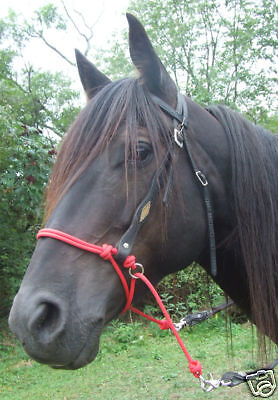

So then I tried looking at bosals/hackamores. Unfortunately, traditional bosals are pretty much only for horses who neck rein (Annie doesn't). In addition, I don't like the weight of a bosal on a horse's nose. So then, what about hackamores?


Ow

Yacht Rope Sidepull Hackamore / Bitless Bridle Attachment - Color Choices

That's gonna hurt!

WHAT the ever-living FUCK?!


I DON'T WANT TO LIVE ON THIS PLANET ANYMORE


Whoooaahh there partner. I think we just wandered into territory best left to Tacky Tack of the Day. Why are there so many monstrosities in the bitless world? Why, in general, are there so many "bitless" bridles out there that rely on pain or gimmicks just as much as bitted bridles do? I'll tell you why:

A horse may be poorly trained, have teeth problems, is not getting enough exercise, is naturally hot/fast, whatever. So the trainer/rider uses gimmicks like evil bits and tie-downs to make the horse behave, rather than fixing the actual problem. The horse becomes super pissy and starts to throw a fit every time you go to bridle it, or pull on a rein. Remove the bit and voila, the horse acts better! Wouldn't you, once metal was no longer being yanked around in your mouth? But after a while, the rider no longer feels he has the control he once did. He can't force the horse's head to drop, or yank and get an instant response. Or maybe the horse just got used to the bitless, and is now up to its old bad behavior. Solution? A hackamore! One with all the ouch of a horrific, sharp, thin, jaw-breaking bit, but on the nose and under the chin instead of in the mouth. This will be another temporary gimmick, because the horse will eventually rebel or become neurotic under the new form of torture, but it works for a while.

You can actually see this process happening in testimonies left on the websites of makers of no-bit bridles. Here's one:


In general though, bitless bridles aren't for "fixing" horses, training is. You horse will continue to toss his head, or pull, or chew, or suffer from bad teeth, or whatever unless you address the actual problem instead of buying new gear. Getting a (true) bitless bridle can be a good way of starting that training, but it's not a substitute for it. That's just common sense! More on that in a bit.

A "true" bitless bridle is, in my book, one that gives fairly minimal control of the head. It's for secondary steering and stopping, basically. Primary stopping and steering? That's what your legs and seat are for. For this reason, I don't particularly like Dr. Cook's bridles. 


This is the patented bitless Dr. Cook system, guaranteed to be effective and humane! ...except, like a nasty hackamore, it relies on pressure to achieve its effects. Granted, there's no thin steel noseband here to crunch a poor horse's nose, but the Dr. Cook model applies significant pressure to the poll and sides of the face. Is a more humane gimmick? Yeah, sure. But once again, it's using equipment to solve a problem.

Back to common sense. True no-bit bridles force the rider to do the work, to build the foundations. The minimal control of the head means you don't get to muscle/pressure your way through an exercise. If you don't practice bending and giving with your horse, that horse won't turn. If you don't practice stopping, especially one-rein stops, you're not going to be able to stop in an emergency. And if you don't practice your aids, there's no bit to send a signal the easy way, and you won't get the response you want. In short, if you ride in a true bitless bridle, you have to be a good rider or else.

I'm not necessarily a good rider, but riding Annie in her halter forces me to try harder. Would I do it on any horse? NO. There are naturally hot/spooky horses out there that are simply not safe to ride without the emergency safety mechanism of a hard metal bit. But if you think your horse is responsive enough, try one-- you'll be a better rider for it.

After all my searching, I did find a few options for Annie and I:

- Tack surgery: shorten the cheek pieces on a standard headstall, patch in a noseband, hope you know what they hell you're doing.
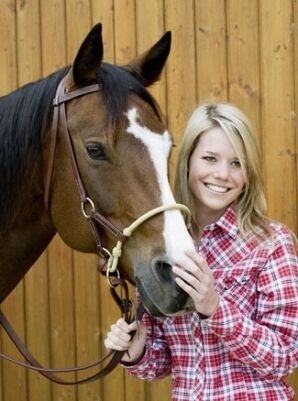
western sidepull

- Try to find a Western side-pull bridle (not that hard) with a humane noseband (harder) in black (harder) that looks pretty (impossible).

- Buy a "Lightrider" bridle. These look pretty awesome, and the come in black, and they look really "nice" for the horse too. And of course, they're only found in fucking Australia and cost a hundred-and-twenty-two dollars plus shipping.

Do you hear that jingle? That's the sound of two paperclips, a penny and a rusty nail, i.e. the "spare cash" I can afford to spend right now. *sigh*

http://www.lightriderbridle.com/uploads/3/6/0/3/3603905/1439166.jpg


Wednesday, September 19, 2012

Full Contact Jousting

Before the period of DOOM that befell my family and I, I had planned on writing about Full Contact Jousting, a "new" old sport that made an appearance at the Alliant Energy Center in Madison (that's the Coliseum for us older folks) in August.

Basically, a bunch of guys get together to beat the crap out of each other with big sticks, whilst in armor, on horseback. I enjoy a little raw bloodsport once in a while, provided it takes place between consenting humans. However, is it safe for the horses?


Let's be clear that "Full Contact Jousting" means exactly that. These guys are not shitting around like the "knights" (actors) you see at dinner theater shows or touristy Renaissance fairs. They've got real armor, real lances and are traveling at a fast canter when they come together. Nor are they attempting to just break lances or touch their opponent's shield-- they are aiming to knock the other guy on his ass. Obviously, there are lots of dangers here for both horse and rider.

Not surprisingly, riders and organizers in this sport are as diverse in their safety concerns as people in any other horse sport. On the side of the angels is Shane Adams, trainer/referee on the History Channel's Full Metal Jousting and long-time jouster, who takes strict precautions. Horses wear armor, including "helmets" and eye-protecting face shields (like those police horses wear). They're further protected from lance hits by a six-foot high solid wall between the jousters. As for training, the horses are impeccably trained, and the riders are told not to interfere with them in any way. Riders even have to drop the reins before each impact, so that if they fall, they can't yank accidentally on the horse's mouth. Finally, Adams has a rule: hurt the horse, on accident or on purpose, and you're gone. This was actually enforced on the show, when one competitor punched his horse after it stepped on his foot. The guy was yelled at and booted off almost immediately. In the History Channel's show, points were taken away if you hit anywhere outside of the special shoulder grid, if you dropped your lance too soon, if you did any number of small things that might result in unsafe conditions (aside from those actually planned for). Rules video here. You can read more about the horses, horsemanship and safety precautions involved here. Sounds pretty safe!


Alas, however, other events have not been so safe. Just like rodeos, there's no one set of rules, no standard safety guidelines, and things can get pretty hairy. I've done a lot of Youtube research and from what I can see, in many events, the riders and their horses are separated only by flimsy ropes, the horses have no armor, and safety is secondary to crowd-pleasing, dramatic smashes. The New York Times article here makes it clear that full contact jousting is pretty gory. The author quoted one young joust spectator as saying, "I want to see another guy get paralyzed." Even National Geographic's show, "The Knights of Mayhem," was reported to be nothing but a chest-beating machismo fest, injected with tons of reality-show drama.

Like I said before, I have no problem with consenting humans hurting each other for fun. Hell, if we had more of it, there would be fewer assholes alive right now. The problem is, these guys are using horses as the tools to do it, with little regard for their well-bring.


Speaking of dicks, check out this knight yanking his horse around at high speeds. The horse is obviously frightened or misbehaving, and is weaving wildly, but his rider pushes him on. In the next pass, the horse mis-steps and flips over on his rider. Both survived, but both could have easily died.

An English jouster did die in January of last year, having been speared through the eye and brain-- read the article here.

Check out this video, where jousters aim for decorated targets on each others' heads, and the unprotected horse nearly gets hit by a splintering lance.

In this video, a crew member actually stands in front of a cantering Clydesdale, waving his arms in an effort to make the horse stop. Thankfully for him, the horse did stop-- but the man was close to being pancaked. Apparently this is common practice, because I saw it again and again in videos. Why not train the horse to stop as soon as a rider falls off?

I have to admit, I didn't find so much as one article or video clip of a horse being seriously hurt during a joust. I feel, though, that this has less to do with any humane sentiments in the sport and more to do with money. Even back when the "real" knights were jousting, there were taboos against hurting horses, simply because the costs of buying, feeding and training the massive beasts were so prohibitive. If you accidentally injured or killed another knight's horse, you had to pay him a very large sum, and you might even be banned from the lists. Today, it can't be much different-- I bet no one wants to be sued over the cost of replacing a prized Freisian or a well-trained Percheron.

I want you to know that I endured many cheesy videos in doing the research for this post. It's like the editors said, "Hey, you know what, I bet we could fit in at least six rock songs, three dragon graphics and some random chanting in this ten minute video!"

By far though, this was the craziest video EVER. It's not even real jousting, but I HAVE to include it here just to make you laugh (or cry). I think it's the actual pinnacle of everything redneck, ever:


Friday, September 14, 2012

UW Madison, Horses for Science & Cat Experiments

Some of you may have a little orange sticker on your driver's license. You've made the decision to donate your organs after your death, in order to save lives or advance scientific knowledge. But what about something as near and dear to you as your own heart-- your horse?

http://www.vetmed.wisc.edu/images/news/endo.jpgJust like doctors, veterinarians need hands-on experience with patients in order to become better at treating them. Dissecting cadavers, human and animal, is a great way to get that experience. For one, there are no consequences if a student slips up with a scalpel. But how does the donation process work?

I spoke with Simon Peek, a professor at the University of Wisconsin Madison, School of Veterinary Sciences, to find out more. Professor Peek has an impressive list of credentials, and an impressively smooth British accent to match. He graduated from Cornell University with the PhD, has co-authored at least two books, and is an expert in things I cannot even pronounce, let alone comprehend. (Theriogenology-- uh, Thare-eeeeooh-ge... yeah, whatever that is.) Did I mention the accent? Very dreamy. That's him there --------->

Professor Peek says that UWSVM takes in less than twenty horses per year, though that number can vary greatly based on the needs of the school. Some horses, usually old or ill, are euthanized almost immediately after being donated, then used for practice surgeries, disease study and dissection. The school is largely interested in accepting donated horses in this category, especially ones with unusual deformities, advanced diseases and other problems, since they are most valuable in teaching students. A few horses, mostly mares, are kept as practice patients for vet students to hone their skills on. Peek is quick to clarify that these procedures are all routine and painless (taking pulses and temperatures, doing ultrasounds, etc). Most rarely of all, according to Peek, is that a healthy horse might be used in "research," i.e. used in experiments.

Peek is wary about this topic, since the recent controversy over cat experiments at the University. He declined to comment on that subject over the phone, except to say that it's making everyone nervous (we'll get back to it in a bit). As for horses, Peek himself is not performing any horse research at the moment, and is unaware of any colleagues that are. He also wanted to emphasize that, "the [school's] first commitment is to the horse." No ill or injured horses are kept that way for study-- they are treated or euthanized immediately.

Speaking of euthanasia, Peek says that all too often, people seeking a cheap way out ask about donating their old horses rather than paying for the cost of euthanasia and burial themselves. "We don't do that," he says. UWSVM is not a good resource for those looking for free assistance. In fact, Peek rather ashamedly goes on to admit that the Vet School is so pressured by "budgetary woes," that, when a horse is accepted for donation, "although we feel extremely self-conscious in doing so, particularly because this is such an emotional time, and people are donating their animal, we usually ask for a monetary donation to help cover our costs." He says that this varies case by case, but usually runs about $200 (still much less than the cost of euthanasia by your regular vet and rendering).

So what do you do if you are interested in donating your horse to the vets for the betterment of human and equine alike? Professor Peek says the process is, "rather ad hoc." You should contact the large animal desk at UWSVM, and eventually someone will talk to you about your horse, what you are willing or not willing to have done to it, and the possibility of donation. Don't get them wrong, they are very grateful for donations-- it's just that they can't afford take every horse offered. Be sure to have all the past vet records for the horse on hand.

I was very appreciative of Dr. Peek's willingness to talk to me, a lowly internet nobody, about these issues. I just wish his colleagues over at the University were a little more forthcoming.

It's the actual University of Madison, not the Vet School, that has been conducting experiments on animals.Though the difference may seem academic, I believe it's important. A good veterinarian upholds the same ideals as a doctor-- first, do no harm. The patient is most important, not the success or failure of a procedure. Researchers, however, operate under a different ideology. Though most researchers are not purposefully cruel to animals in research (simply because doing so might skew the test results) neither are they particularly concerned about an animal as an individual.

Let's back up a second. If you've been living with your head under a rock, you may not know that PETA has accused UW Madison of cruelty on and off for decades because they conduct animal experiments. Some of it is probably justified (decompression experiments on sheep) and some of it probably isn't (milking a cow is not like rape). Most recently, PETA has caused an uproar about a cat named Double Trouble (article here). Double Trouble was used in experiments involving cochlear implants, devices which allow deaf people to hear. They wanted to know more about how the brain locates the origin of a sound. During the experiments, they did some fairly gruesome things, though all with pain medication and all within the limits of the law. PETA, however, has provided some pretty convincing evidence that these cats, Double Trouble especially, suffered. More pictures here (warning: pretty awful).


PETA got these pictures, and the evidence for the cats' suffering, from the UW's own records by legally requesting them via a nice little law that says government funded places have to reveal everything they do.

Now, I usually hate PETA, and I'm not necessarily against animal experimentation (except for experiments on primates-- go fuck yourselves on that one, scientists. And couldn't we just use convicted child molesters for everything instead?). We've used animals to develop pretty much every vaccine, heart implant, life-saving medication and complex surgical procedure known to man, benefits I've reaped myself. Were it not for animal experiments, I'd be a half-blind, one-armed crazy woman with constant ear infections and six kids. And there's just no way around it-- we still need animals (or criminals) to develop more of that stuff. No matter what the idealists would have you believe, a computer will never be a substitute for a living organism. However, I have several problems with this particular crap:

1) It does seem like there was unnecessary suffering in this case.

2) We don't know that this research was in any way important. UW Madison has passed it off as "cochlear implant research." Uh, we have those available to the public already, they work great. What's this really about? Because if it's building a better war machine, or research for the sake of research.... ugh.

3) Why don't they talk to us?

 Professor Peek, a pretty important guy, was cool enough to walk me through the ins and outs of donating horses to the UW Vet School. He even talked about some of the controversial stuff, like asking for money from horse owners, experiments on horses and using live horses as practice patients. He was willing to talk about things he was slightly embarrassed about, to a random person on the phone, in a way that made sense. But the best that the University can do is issue a statement that basically says, "We didn't do anything wrong."

Listen up UWMad. I'm willing to be on your side in this, but not if you act like a shady motherfucker. Talk to us. Tell us, in plain English, what these experiments are really about, why you believe the suffering of these cats was justified, what you did wrong, and how you can do better. Nothing says "guilty" to me like clamming up. I understand if you aren't allowed to talk specifically about the research because it involves patented techniques or whatever, but tell us that, then do your best to explain without revealing any tech secrets. It's not hard, we don't need the technical stuff!

I'm sure PETA and other hard-liners would blame UW Mad no matter what, but for the average Joe, a little explanation would go a long way. Without that explanation, I'm forced to err on the side of PETA. And Lord, do I hate doing that. One of the reasons Professor Peek and his colleagues are nervous is that PETA likes to throw around fake blood, harass vets and scientists, and fund terrorist groups like ALF that attack people and burn down buildings. But that's an expletive-filled post for another time.

http://nshima.typepad.com/photos/uncategorized/2007/12/13/gotpus.jpg?w=300&h=300http://ficdn.fashionindie.com/wp-content/uploads/2009/01/0228_peta_protest_getty_21.jpg
...fucking lying shock-jock hypocrites.


Saturday, September 8, 2012

Scum Breeders (?), Lol Pics & Purple Carrots

Apologies for the late post again! I've been busier than usual. It really looks like my dream is coming true-- I'm going to be moving to my family's farm, where my horses are boarded!! ...as soon as the rennovations are complete on the 1951 mobile home out there.


 Uh yeah, it's gonna be a while. Uck. I'm not sure how I feel about living in a trailer, but Hell, I guess I'd live in a shack in order to live in the country with my horses. Actually, this entire front end is now a gaping hole, so there's been significant progress already.

Anyway, let's move on.

I ran across a Facebook group listing grade/part Arabians for sale in OH, IN and MI. One poster, Sheri Mose, had some very interesting things to say about an Arabian breeder in MI. When another group member asked about the possibility of tracking down a certain horse, Sheri said that the stud in question had been neglected and then dumped by his owner, Sandra Bristol.

Apparently Sandy bred Egyptian Arabians in Michigan, possibly around the Rapid River area, and maybe  was a neglectful, abusive scumbag breeder. If you know of anything that either corroborates Sheri's story or proof that Sheri is simply launching a character attack, please post!

I have another story of this kind, but one I'm far more sure about. I've though long and hard about writing about her, and I think the legal trouble I could get in is less important than warning folks. However, I want to hold off a bit longer until I make some more phone calls. For now, let's just say that I highly recommend staying away from Michele Macha, a breeder and trainer in Lena, WI.

It's the weekend, so let's inject some levity, eh? Have a great day or two off!


Purple carrots? Yep, this article explains how they were the norm not long ago, until orange became the popular color!

Now then, how about some more lol pics?

Multi-colored carrots
Stupid bit, Awesome mask!! Just don't bring him near any mirrors-- he'll spook!


Wednesday, September 5, 2012

Richland Center Rescues: sketchy RAR vs quality Ocooch

First, a few brief news bulletins.

Another case of EEE was confirmed in Wisconsin. Remember to vaccinate!

A Dane County judge has ruled that dogs cannot be used to hunt wolves in Wisconsin. The DNR will uphold the ruling, but hasn't re-written any rules yet, and is planning on going ahead with the wolf hunt in October.

There was a neat article for horse lovers and Packer fans alike in a Milwaukee paper recently; click here to read it.
 
Now then, on to the part where I rant:

Richland Area Rescue worries me. Nay, angers me.

Although they don't appear to be actively breeding animals, their behavior raises several red flags.

-Not all animals are spayed/neutered/gelded
-Not all animals appear to have basic vaccinations

-Until recently, the kennels were primitive, with dirt floors
-Some animals don't have minimal basic training
...and other sketchy stuff.

Let me give you an example. I was tipped off about RAR when a watchful horse rescuer emailed this Petfinder ad to me:

https://mail-attachment.googleusercontent.com/attachment/?ui=2&ik=68e1d9545a&view=att&th=1399361a8616641d&attid=0.1&disp=inline&realattid=f_h6pkdbn80&safe=1&zw&saduie=AG9B_P-AyQEAMKEBfD5YP6r4qYbz&sadet=1346876529229&sads=9MPgzSSu9gFbB8EvU3fEUdslo5Q&sadssc=1
Click to enlarge


1) Why is this pony not gelded?! Especially when they admit "he should be gelded?!" RAR, you're a rescue, do your damn job!

2) He's been "sat on" but "isn't broke." Okay, who sat on an unbroke mini? A kid? Great, awesome child endangerment. An adult? Awesome, great way to permanently damage an animal. Let's skip straight past my usual argument of "two year old horses should NOT be made to carry weight," and go on to a rant about minis and "being broke."

Minis aren't really meant to be ridden. Like pot-bellied pigs, their main purpose is to look adorable and possibly to pull tiny carts. Can they be ridden? Sure. But they probably shouldn't be. Unless you have a midget volunteer, you're either breaking a horse to ride with a child as its trainer/rider, OR you're using the crushing weight of an adult. Either way, you suck. Are there ways to train a mini without endangering a child or squishing said equine? Well... yes. Effective ones? Ehhh.... maybe. That's a debate for another time.

Let's take a look at some other sketchy stuff at RAR:

This horse isn't guaranteed sound-- she has problems in her whole back end. RAR doesn't know what's wrong with her, because apparently they don't want to pay a real vet to find out, but after a cursory look from a vet tech, they guess she'll be okay for light riding with a light rider. This sounds totally safe.

This mare looks a bit too ribby in her pictures, and her colt is 5 months old, but  "hasn't had anything done with him." Yikes, when do they plant to start halter breaking? When he's big enough to really hurt someone?

Emilita and Prince: Arabian, Horse; Richland Center, WI


This pony is unbroke, but is being advertised as, "she could make a great birthday present for a little kid." I shall now repeat the obligatory mantra: "Animals should not be given as presents." Shouldn't a rescue know not to use this as a selling point?

...and there not-fixed puppies up for adoption without all their shots, unclear adoption prices, no mention of a return-to-shelter requirement when a pet doesn't work out, etc etc.

I think the argument could be made that I'm mostly nit-picking here. By themselves, each of these complaints might be petty. And even put together, they don't add up to actual abuse. It might be a little rough-and-ready, back-woods, poor quality type of rescue, but they're trying, right? And there are certainly camps of people who believe that rescues who help many animals a little are just as good as rescues who help a few animals a lot.

However, I cannot and will not forgive any "rescue" or "shelter" for not spaying/neutering/gelding animals in their care. Animals wind up in shelters because they are unwanted. How do we have unwanted animals? Largely, because we've allowed too many of them to breed.And sending an unfixed animal out the door is an invitation for it to breed.

Richland Area Rescue does say, "We are working towards having all dogs and cats spayed and or neutered before adoption." They also have a one-page contract, part of which states that any animal adopted needs to be spayed/neutered/gelded within 30 days of adoption. But to me, these are flimsy mechanisms. RAR should just act responsibly, dammit.

Interestingly, there is another rescue in Richland Center: Ocooch Mountain Humane Society. They have a much nicer website, a bimonthly low-cost spay-and-neuter program, regular fundraising events, a much more thorough adoption application, and all their animals are fixed and have all their shots. Ocooch is still small; they only have a facility for cats (dogs are all privately fostered) but you can tell there have a quality operation.

So why is it that RAR has gotten the Richland County contract to take in strays, not the better-run Ocooch? I'm guessing RAR underbid Ocooch for the contract. That's a shame. If you're from the Richland Center area, please take a moment to tell your city government to spend your tax dollars at a higher quality facility that really cares for animals. (Click the link and then scroll down for contact info for city officials.)

I contacted Ocooch to ask them about the county contract as well as their operation versus RAR's, but didn't hear back by press time*.

*Update: never ever heard back from them.


Sunday, September 2, 2012

Craigslist Game!


This game is called, "How Many Stupids?" List all the utterly idiotic statements and/or awful care-taking practices in this ad! I found 12-- can you find more?

image 0

"5 year old Arabian Stallion. He has been in same spot most of his life. He was halter trained at one point but hasn't had a halter on him in a few years. He is a great horse. Never had any problems with him. He'd make a great horse if you have time to break and train him. Very beautiful horse. He loves to lay on the ground and stretch out. Loves his basketballs and his paper bags. He has not been around any other horses in 4 years.

We are planning to travel and are looking for a good home for him. I can whistle for him or call him by name from anywhere and he'll come running. So tell me what kind of home you have for him. He's only been in a trailer once when he was about 6 months old.

To RE Clarify a few things: He is Arabian. He is not registered and has no papers. I've never been interested in the "resale" value of an animal. I'm not desperate to get rid of him. He's safe and content where he is.

He would be a great horse to be trained for a riding stable. He's not a huge horse so, once trained, he would be great for kids or adults.

For more information, Please email me."

  1. No information on height, health, ground manners, Coggins, etc etc
  2. Nice pic of him rearing... and biting something?!
  3. Not even halter broke, in a year where broke horses are going for meat prices
  4. Uh, "loves to lay on the ground?" Great, I like to sit on my ass. Give me a medal!
  5. Loves basketballs? Is he training for the NBA?
  6. Loves paper bags?! Like, over his ugly face or what?!
  7. Totally unsocialized-- no equine contact since he was a yearling
  8. "So tell me what kind of home you have for him" ...uh, a better one than yours?!
  9. Doesn't trailer
  10. Not gelded, registered, halter broke, broke or apparently handled in any way-- in short, the least desirable horse EVER
  11. Has an owner not interested in the "resale value" i.e. general well-being, of a horse
  12. Not huge = for kids? HAH HAH HA HA HA

If you thought that was fun, check out this ad ("I have a 2 yr old paint stud that we got as a pasture mate for our younger filly...") and this one! Tell us how many stupids YOU counted!

Friday, August 31, 2012

LOL Pic Friday

"DUDES, look at this water tank!"

How not to blindfold a horse.


...HUSBANDS TRY TO HELP


"OMG did you see that trench?! I could have fallen in and DIED!"


Don't actually try this at home!     


Thursday, August 30, 2012

Horse Fad Predictions: Hairless Horses & More

Months ago, I jokingly talked about how "wiener horses" could become a big fad. Certainly, we already have fans of dish-faces, curly coats, blue eyes, etc, just like in the dog world, where we've bred for every weird trait imaginable. But what about hairless?


Yes, there are hairless horses. The horse above is called "Harry," And I predict that, within the next ten years, we'll see a fad of these, just like the current Gypsy Vanner fad, or the old Chintagoue Pony fad. The only things standing in the way are that hairless horses tend to have many more health problems, including sun burn and skin lesions, and the hairless trait is hard to breed for. You can read more about hairless horses here and here (scroll down a bit) as well as the history of very hairy horses...


Other upcoming fads? Totally Fell Ponies. They're black, pretty, and have lots of hair, just like the currently popular Friesian, but they eat less and take up less space. Also like the Friesian, they have the "European" mystique.


What do you think will be the next big horse fad?